Imitation Learning in Robotics: From Human Demonstrations to Reliable Skills
Updated: Sep 15
Coding a robot to pick up a grape used to take months of math. Now, an expert can show a machine how to do it in minutes. This shift marks a new era for robotics.
Using human data to train machines is a fast way to build reliable systems for any research lab. To use this tool well, you must first understand the core ideas of how policies model physical skills from these observations.
What Is Imitation Learning in Robotics?
Imitation learning in robotics enables machines to learn complex manipulation and navigation tasks directly from expert demonstrations. By recording human guidance, such as teleoperation, and training neural network policies, robots skip the tedious trial-and-error phases of reinforcement learning and gain human-like coordination quickly.
Imitation learning in robotics enables robots to gain new skills by mimicking human experts. Instead of coding every trajectory, an expert demonstrates the task, and the robot replicates those actions. This allows systems to pick up fine motor skills that are hard to describe mathematically.
Experts define scholarly analysis on robotic learning as a process where a machine learns to act by copying an expert. This removes the need for teams to write hard rules for every small step. It makes it easier to teach robots how to handle tasks that involve hard touch or sight. By using human data, robots can skip the long trial and error phase seen in other methods.
Learning from expert behavior
To start the work, a person often uses teleoperation to guide the robot arm through a task. This expert showing gives the robot a set of data to study. The robot looks at the expert's path and tries to match the same states and actions. High quality data is the key to making this work well. If the expert makes a mistake, the robot might learn that mistake too.
Using these demos has a few key perks for research teams:
It speeds up the training time for new skills.
It allows robots to learn from human insight.
It reduces the need for hand-made reward functions.
It helps robots work in real-world settings faster.
Comparing learning methods
There are two main ways robots use this data. The first is behavior cloning. It treats the expert data as a simple task to map states to actions. Almost half of recent studies on robot movement research paper on behavior cloning as a base. It is a fast way to get a robot moving. But it can fail if the robot sees a state that was not in the demo data.
The second way is inverse reinforcement learning, where the robot deduces the goal behind the expert's moves to adapt better to new environments. While behavior cloning is simple, newer the introduction of diffusion models in robotics help robots handle complex, noisy tasks without losing success.
Solving complex tasks
Imitation learning is great for tasks that are too hard for manual coding. For example, robots have used it to walk on rocky ground or open doors. In these cases, it is much faster than standard reinforcement learning. In reinforcement learning, a robot must try and fail many times to find a reward. With imitation, the robot gets a clear map from the start. This saves time and keeps the hardware safe from damage.
A major challenge is covariate shift, where small errors drive the robot into states it never saw during training, causing task failure. Large, varied datasets help solve this issue. Advanced tools like the ALOHA system help teams collect the massive amounts of data needed to overcome these shifts and stabilize the policy.
Core Methodologies of Imitation Learning in Robotics: Behavior Cloning vs. IRL
The primary methodologies of imitation learning in robotics are behavior cloning. Which maps observations directly to actions via supervised learning, and inverse reinforcement learning, which deduces the expert's underlying reward function. Behavior cloning is computationally simpler, while inverse reinforcement learning excels at generalizing to novel environments.
When you set up peer-reviewed research on imitation learning, you must choose how the agent learns from expert data. The two main ways to do this are Behavior Cloning (BC) and Inverse Reinforcement Learning (IRL). Each path has a different way of turning expert moves into a robot skill.
Supervised Learning with Behavior Cloning
Behavior cloning is a very common way to start. It treats the problem like a supervised learning task. The robot looks at the state of the world and tries to map it to the exact action the expert took. It is a fast way to get results. In fact, it is used in about half of all legged robot studies (PubMed Central article). You can use the Trossen SDK data collection tools to gather this expert data and start training your models quickly.
But BC has one big flaw. It is called covariate shift. If the robot makes a small mistake, it might end up in a spot it never saw in the training data. Since it does not know what to do next, the error grows until the task fails. New tools like diffusion models in imitation learning policies help fix this. They give the robot a better way to handle complex data.
Deducing Goals with Inverse Reinforcement Learning
Inverse reinforcement learning takes a different view. Instead of just copying actions, the robot tries to find the goal that the expert is following (recent arXiv preprint on inverse reinforcement learning). Once the robot knows the goal, it can use reinforcement learning to find the best way to reach it. This helps the robot handle new situations that the expert did not show.
IRL is harder to set up. The robot must check many possible goals. But it leads to a more robust system that can adapt when the world changes. For researchers, this means the robot can solve tasks even when the start state is new. Using reliable highly agile mobile AI robot bases gives you the stable hardware needed to test these complex reward functions in the real world.
Feature | Behavior Cloning (BC) | Inverse Reinforcement Learning (IRL) |
Primary Logic | Maps states to actions directly. | Finds the expert's goal. |
Learning Type | Supervised learning. | Reinforcement learning with a deduced reward. |
Main Benefit | Simple and fast to implement. | Better at handling new situations. |
Key Weakness | Sensitive to small errors. | High math and compute cost. |
Data Source | Direct expert state-action pairs. | Full expert paths. |
The End-to-End Workflow of Imitation Learning in Robotics
The workflow of imitation learning in robotics spans expert demonstration, high-fidelity observation capture, dataset formatting, policy training, and real-world evaluation. This iterative process refines the robot's policy by continuously collecting error-recovery data to resolve failures and ensure robust operation.
The path from a human skill to a robot task has several clear steps. Each phase helps the robot learn to copy expert moves with great care. By using a set plan, teams can move from first tests to live use in less time. This flow helps labs build systems that work in the real world.
How do we gather expert data?
The process starts with an expert showing the robot how to do a task. In many cases, this happens through teleoperation. A human uses a master unit to move the robot arms. This allows the system to record exact joint angles and force. High-quality data is the main fuel for clinical literature on policy learning. Without good examples, the robot cannot learn the fine details of hard tasks.
During these demos, sensors record every part of the work. This includes camera feeds, depth maps, and touch data. This data forms the space that the model will later use to make picks. Recording many expert paths helps the robot handle small changes in its nearby area later on. Most basic tasks need about 50 to 100 clean demos to start.
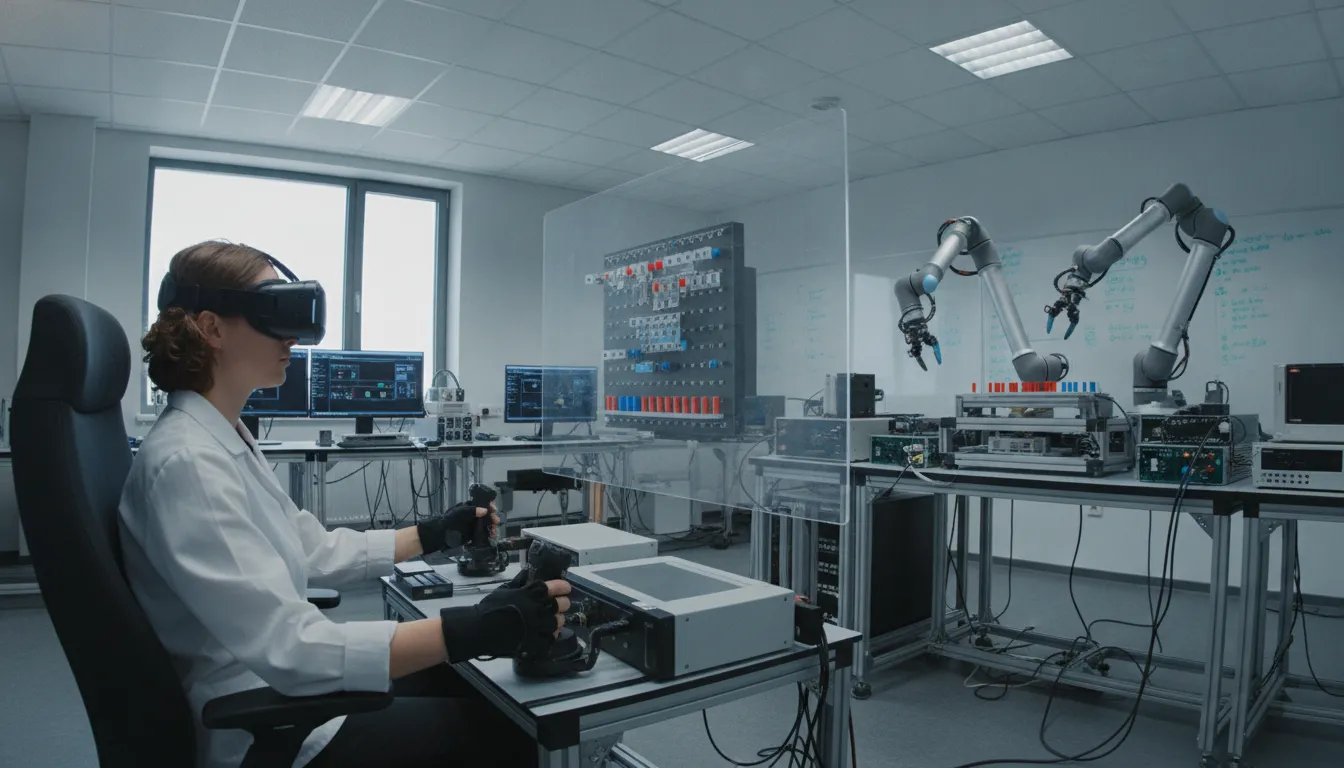
Bimanual robot data collection using teleoperation for imitation learning in robotics.
- Demonstration Gathering:
Use teleoperation or hand-guiding to show the robot the target task many times.
- Observation Capture:
Record all sensor data, like video and joint spots, to build a full map of the space.
- Training Data Formatting:
Clean and sort the raw files into a set that machine learning models can read.
- Policy Training:
Feed the data into a neural network to create a rule set that maps sensor inputs to motor acts.
- Physical Evaluation:
Run the trained model on the real robot to see how well it copies the expert in the real world.
- Iterative Improvement:
Find where the robot fails and gather more data to fill those gaps until the skill is solid.
Processing data for policy training
Once you have raw data, you must prepare it for the learning model. This often involves cleaning noise from sensor feeds and timing signals. Teams use tools like the open-source robotics data collection suite to turn these records into standard files. This step is needed for training models which need clean inputs.
The goal is to map what the robot sees to the act it should take. This is known as behavior cloning. It treats the data like a simple teaching task. The model learns a policy that tells the motors what to do based on the current view or joint state. This way of working is simple but strong for many robot tasks.
New methods also help the robot move more smoothly. For example, some models use Action Chunking Transformers (ACT) for sequential trajectory modeling to group moves together. This cuts the work for the AI and leads to better flow. By grouping acts, the robot can handle tasks that take a long time to finish.
Evaluating and refining the model
After training, the robot must try the skill on its own. Engineers watch for errors like "covariate shift." This happens when small slips lead the robot into a spot it never saw during training. If the robot gets stuck, it may not know how to fix it. Testing in the real world shows these weak spots fast.
To fix these issues, you must add more data. You can record new demos that show the robot how to get back on track. This loop of testing and adding data is the key to building smart machines. Over time, the robot becomes better at handling new scenes and quick changes. Using a stable robot base makes this loop much easier to manage.
Good hardware also helps make sure that the data you collect is the same each time. If the robot has play in its joints, the model will struggle to learn fine motor skills. High-grade systems provide the data quality needed for research that scales. With the right tools, the path from idea to a working robot skill is much shorter.
How Diffusion Models and ACT Elevate Robot Manipulation
Diffusion Policy and Action Chunking Transformers (ACT) revolutionize imitation learning in robotics by resolving multi-modal human action distributions. Diffusion models prevent blurry averages by choosing distinct trajectories, while ACT uses action chunking to predict sequences of future actions, resulting in smooth, high-precision bimanual coordination.
Modern uses new AI tools to turn expert demos into reliable skills. Experts define this as a way where a robot learns by copying a person, not by using set rules National Library of Medicine publication. Early tools often struggled with hard real-world tasks like grasping or sorting. Today, two tools lead the way: Diffusion Policy and Action Chunking Transformers (ACT).
Solving the varied action problem
One major task in robot learning is that humans move in many ways. When a person does a job, they might take different paths to reach the same goal. Simple tools often blend these paths. This leads to blurry or failed moves. Research shows that diffusion-based policy architectures solve this. They learn all likely paths. This lets the robot pick one clear way to move instead of a weak mix.
Diffusion models work by adding noise to data and then learning to take it out. This process helps the tool handle messy demos from human experts. By turning a random start into a precise act, the robot can manage the ways people move. This makes the tool tough when it faces new spots that differ from the training data.
Smooth motion with action chunks
Another big step comes from Action Chunking Transformers (ACT). Not just picking the next step, ACT picks a short string of future acts at once. This way, called action chunking, creates a much smoother flow. It stops the jerky moves seen in older tools that tried to react at every split second.
ACT works well for high-precision work. In bimanual robot experiments with high-precision alignment, teams use these models to run two arms at once. Picking action chunks helps the arms stay in sync. This is key for tasks like peg insertion or folding cloth. The transformer parts let the robot focus on the most vital bits of its sensor data.
Managing data errors and shift
A common problem in is covariate shift. This happens when small errors build up. These errors push the robot into a state it never saw during training. Modern tools like ACT and Diffusion Policy help fix this. They are less prone to small sensor noise.
Data from experts often has errors or pauses that do not help the robot learn. These models use smart math to ignore the junk and focus on the goal. By pairing good data with these new models, teams can train robots for tasks that were once too hard. These systems move from lab tests to real-world use much faster than before.
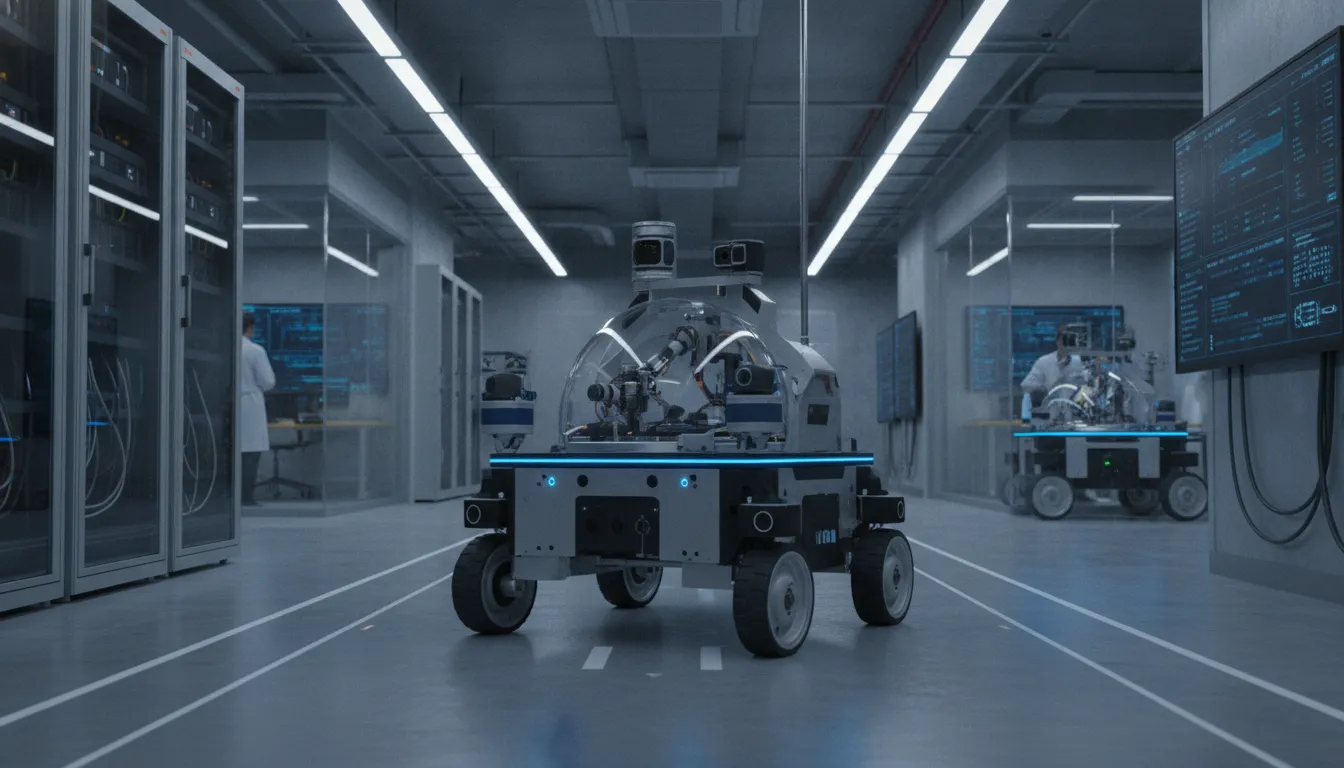
Testing autonomous navigation policy trained with imitation learning in robotics.
Diffusion Policy manages varied expert demos.
ACT provides steady flow for smooth movement.
Action chunking reduces the impact of small control errors.
Transformer layers help the robot focus on key visual cues.
Overcoming Common Failure Modes in Imitation Learning in Robotics
Overcoming common failure modes in imitation learning in robotics requires addressing covariate shift and data scarcity. By using high-quality demonstration pipelines, model-predictive control, and robust platform frameworks, developers can ensure policies generalize successfully to novel environments and maintain operational stability.
Robots often struggle when they face new scenes. A small mistake can lead to a big failure. This happens because the robot does not know what to do in states it never saw during training. In peer-reviewed study on robotics learning, these gaps in data cause major hurdles for developers.
Solving covariate shift
Covariate shift is a core problem in robot learning. It occurs when small errors build up over time. These errors push the robot into a state that was not in the original data. Because the robot has no guide for this new state, it cannot fix its course. This often leads to the robot moving in ways that are not safe or useful.
To fix this, you need high-quality data. Many teams now use model-predictive control (MPC) frameworks to create better training sets. This method helps the robot learn how to stay on track even when things go wrong. High-end teleoperation systems also help. They allow humans to show the robot how to recover from small slips. By seeing how an expert handles a mistake, the robot learns to be more robust.
Handling data scarcity
Robot training needs a lot of data. Collecting this data is often slow and costs a lot of money. Without enough expert demos, the robot cannot learn complex skills. This lack of data is a major block for many labs. Most teams find it hard to scale their work because they cannot get the data they need fast enough.
You can beat this by using better data pipelines. Systems like the integrated Trossen SDK make it easy to collect and move data. These tools help you turn human moves into clean data for AI models. When you have a solid way to capture and store data, you can build larger sets with less effort. This helps the robot learn faster and perform better in the real world.
Improving data quality
A good pipeline does more than just store files. It ensures the data is ready for the model to use. Clean data leads to better results in advancements in diffusion models for manipulation. If your data is messy, your robot will be clumsy. A smooth workflow from human demo to model training is key to success.
High-quality hardware also matters. If the robot arm is not precise, the data will be poor. Standard tools allow you to focus on the AI rather than fixing the gear. When you use tested systems, you get better data every time. This means you need fewer demos to reach the same skill level. Better tools save you time and help you ship faster.
Trossen Robotics: Research-Grade Platforms for Practical Physical AI
Trossen Robotics provides out-of-the-box, research-grade robotic platforms designed to accelerate imitation learning in robotics. Our systems integrate seamlessly with LeRobot, Hugging Face, and ALOHA frameworks. Featuring the Trossen SDK and lifetime technical support to help labs go from unboxing to model training on day one.
Many labs waste weeks just getting their robot arms to talk to their software. recent research on physical AI policies solves this by letting robots learn directly from expert demos. Trossen Robotics provides out-of-the-box platforms you need to start this work on day one. Our systems come ready to run so you can focus entirely on your models.
Faster data collection and training
The our hardware-compatible data collection package helps you move from hands-on control to model training fast. It works with standard tools like LeRobot and Hugging Face, letting you plug your data into top AI systems without extra steps. Our robots are built for the ALOHA setup, the main tool for bimanual manipulation. High-quality data is the main fuel for any robot learning project. Our platforms record joint moves and sensor readings cleanly, ensuring every data point is useful for your neural networks so you can focus entirely on the science.
Built for fast setup
We build our platforms to be more than just a box of parts. Every system is tested and tuned to work the moment it hits your lab bench. Letting you go from unboxing to your first data run in just a few hours. By removing the walls between your code and your hardware, we help your team hit milestones on time. Our platforms come with high-speed robot arms for precise move control, built-in sensors for real-time data feeds, and stable mounts. These research-grade machines are built for heavy use in busy labs, using tough motors and exact sensors to stay steady over months of heavy testing.
Lifetime support for every researcher
We back every system with lifetime support to help you stay on track, offering a 48-hour response time to ensure you never get stuck. As your needs change, our modular design makes it easy to add new parts or upgrade your system. Many of our customers start with a single robotic arm and grow into full fleets of mobile AI units. We are your partner from your first test to scaled physical AI deployments, helping you move the field of robotics forward.
Frequently Asked Questions
What is the difference between behavior cloning and inverse reinforcement learning?
Behavior cloning treats demo data as a task where a machine learns to map a state to a move. It works like simple learning. In contrast, inverse reinforcement learning looks at paths to find a hidden goal or cost. This helps the robot use those rules in new places. According to theoretical research on goal deduction, these two paths offer other ways to teach robots how to act on their own without human help.
What are the common challenges in imitation learning?
One major issue is called covariate shift. This happens when a small error makes a robot go into a state it did not see during training. Because the robot does not know what to do, the error grows over time. Good data is also hard to find and can be very pricey. As noted in a published paper on imitation learning challenges, these gaps often stop a robot from working well in the real world without expert help.
How does imitation learning help robots move on rough ground?
This method helps robots with legs walk on hard paths like rocky hills or doors. Instead of a human writing long lists of math rules for every step, the robot copies how an expert moves. This makes it less hard for the system to learn how to keep its balance in tricky spots. Academic work from the National Institutes of Health study shows that this path removes the need for humans to hand-build every reward for the robot.
How can I collect data for robot imitation learning?
You can use tools to record a human expert as they guide a robot through a task. This is often done with hands-on tools or remote control systems. Good data is the fuel for skill gain, and systems like the our open-source data collection system help make this work fast and smooth. By using standard file types, users can quickly move from collecting data to training their models for real use in labs or shops.
Ready to scale your imitation learning research?
Delaying your hardware setup creates a gap between your models and the physical world. Starting with a stable platform now means you get clean data faster and reach your next research milestone sooner. Our systems help you move past integration tasks so you can focus on building intelligence that works in real life. Ensuring your hardware is ready to go in hours, not weeks, so you can test your new ideas right away.
Ready to schedule a free consultation? Talk to a robotics expert to schedule a free consultation.
Comments