Robot Teleoperation for Physical AI Data Collection
Updated: Sep 15
Robot teleoperation lets a human operator control a robot while the system records synchronized actions, observations, and task outcomes. For physical AI teams, it is a practical way to collect demonstrations of manipulation skills that can become training-ready datasets for imitation learning and related robot-learning workflows.
The value of teleoperation is not simply that it moves a robot remotely. A useful system captures what the operator intended, what the robot did, what its cameras observed, and whether the task succeeded. When these signals are recorded consistently across many episodes, demonstrations become a reusable data asset instead of a collection of disconnected trials.
This guide explains leader-follower workflows, operator interfaces, camera and sensor planning, latency, repeatability. Single-arm and bimanual use cases, and the steps that turn demonstrations into datasets suitable for model development.
What Is Robot Teleoperation?
Robot teleoperation is the remote or indirect control of a robot by a human operator. In physical AI data collection, the operator demonstrates a task while the system records robot state, commands, camera observations, timing, and episode metadata. The resulting demonstrations can be reviewed, filtered, converted, and used for training.
The operator supplies real-time judgment that an untrained policy does not yet have. They can adjust grasp approach, react to object movement, recover from small errors, and complete tasks that are difficult to specify with a fixed script. Teleoperation therefore provides a direct path for capturing expert behavior in the robot's actual workspace.
A complete teleoperation data loop includes four layers:
- Control:
an operator interface produces commands for the follower robot.
- Observation:
cameras and robot sensors capture the state of the task and system.
- Recording:
a data pipeline timestamps and stores signals throughout each episode.
- Review:
the team labels outcomes, removes unusable episodes, and converts accepted data for training.
How Does Leader-Follower Robot Teleoperation Work?
In a leader-follower workflow, the operator physically moves a leader arm, and a follower arm tracks the commanded motion. This gives the operator a direct, intuitive control interface while keeping the task execution and data capture on the follower system. It is especially useful for collecting manipulation demonstrations.
- Prepare the workspace.
Place objects, fixtures, cameras, and robots in documented starting positions.
- Initialize the pair.
Connect the leader and follower, verify their configuration, and confirm safe motion.
- Start an episode.
Begin recording before the operator initiates the task.
- Demonstrate the behavior.
The operator moves the leader arm while the follower performs the corresponding action.
- Record observations and states.
The pipeline captures camera frames, robot state, and other configured signals.
- End and label the episode.
Mark success, failure, or a specific reason for rejection.
- Reset consistently.
Return the environment to the documented initial condition before the next demonstration.
Trossen Robotics' WidowX AI is available in leader and follower configurations. Trossen AI systems pair these arms with camera and compute options for teleoperation, dataset recording, and inference testing. The Trossen Arm documentation also provides a verified LeRobot workflow for recording episodes with configured leader, follower, and camera devices.
Robot Teleoperation Workflow: Demonstration to Dataset
A training-ready episode needs more than a successful motion. It needs synchronized observations, consistent task definitions, reliable timing, and enough metadata to make the demonstration understandable later. The workflow below shows the essential path from operator action to usable dataset.
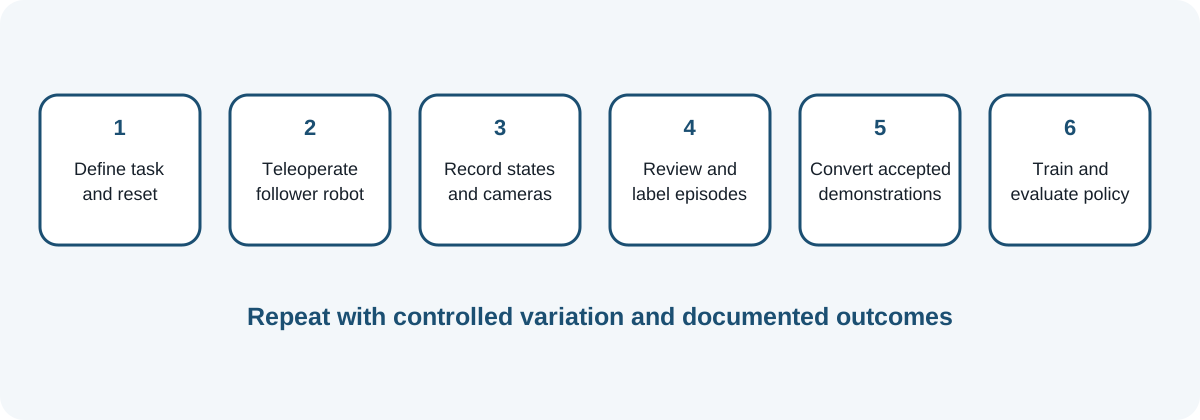
Robot teleoperation workflow for converting demonstrations into training-ready data.
The Trossen Data Collection SDK supports this recording layer with a modular, open-source C++ framework. Its configuration-driven pipeline defines hardware addresses, camera resolutions, producer poll rates, teleoperation pairings, episode duration limits, and backend parameters. The SDK records TrossenMCAP and supports direct conversion to LeRobot V2 format for use with LeRobot training workflows.
Which Operator Interface Is Best for Data Collection?
The best operator interface is the one that gives the operator enough control to complete the task consistently without introducing avoidable fatigue, delay, or ambiguity. Leader-follower arms are a strong fit for manipulation because the interface maps the operator's arm motion directly to a similar robotic mechanism.
Other interfaces, such as joysticks, gamepads, keyboards, or 3D input devices, may fit mobile navigation or specialized controls. The selection should follow the task, degrees of freedom, need for precision, operator training burden, and the signals that must be recorded. A familiar interface is not automatically a good data-collection interface if it makes fine manipulation slow or creates inconsistent commands.
Evaluate an interface against these questions:
Can an operator learn it quickly and repeat the same task without excessive fatigue?
Does it expose all required degrees of freedom and gripper actions?
Can commands and robot states be recorded with reliable timestamps?
Does it support safe recovery when the task deviates from the expected path?
Can multiple operators follow the same written protocol?
Camera and Sensor Planning for Robot Teleoperation
Cameras and sensors determine what the eventual model can observe. A strong setup gives the policy enough visual and robot-state context to distinguish task stages, locate relevant objects, and associate operator actions with changes in the environment. Poor placement can hide critical interactions even when the demonstration succeeds.
Choose views around the task
Use an external scene view to capture the overall workspace and a closer view when fine interactions or occlusion matter. Wrist-mounted cameras can preserve a close perspective as the arm moves. Before collecting at scale, inspect sample episodes for glare, motion blur, blocked views, background distractions, and objects leaving the frame.
Keep the configuration repeatable
Document camera mounting points, angles, resolution, frame rate, and exposure settings. Consistency matters because an unexplained camera change can look like task variation to a model. Trossen's Stationary AI and Mobile AI systems use multi-camera configurations designed for repeatable collection. While the Data Collection SDK allows camera resolutions and producer poll rates to be defined in one JSON configuration.
Record robot state with visual observations
Camera images explain what happened in the workspace, while joint state and related signals explain how the robot moved. The Trossen Data Collection SDK provides protocol buffer schemas for JointState, RawImage, and Odometry2D messages with monotonic and real-time UTC timestamps. The exact signal set should match the robot, task, and planned learning pipeline.
How Do Latency and Repeatability Affect Data Quality?
Latency affects how closely the follower responds to the operator, while repeatability affects whether demonstrations are comparable across episodes. High or inconsistent delay can cause corrections, overshoot, and unnatural pauses. Uncontrolled resets, camera shifts, and changing task definitions can make otherwise successful demonstrations difficult to interpret.
Teams should measure latency rather than assuming it is acceptable. Watch for delay between leader movement and follower response, unstable camera frame rates, dropped observations, and timing drift between streams. Trossen Robotics uses Ethernet and UDP communication for low-latency PC communication with WidowX AI. And its SDK uses a lock-free multi-producer single-consumer queue with a background drain thread to support recording.
Repeatability does not mean every episode should be identical. Useful datasets often include deliberate variation in object position, lighting, operator style, or task path. The important distinction is between controlled variation, which is documented and relevant, and accidental inconsistency, which obscures what the model is meant to learn.
Single-Arm vs. Bimanual Robot Teleoperation
Single-arm teleoperation is appropriate when one manipulator can complete the task, while bimanual teleoperation is appropriate when the task requires coordinated two-arm behavior. The choice changes the hardware footprint, operator workflow, reset protocol, camera plan, and complexity of the recorded action space.
Consideration | Single-arm teleoperation | Bimanual teleoperation |
Best suited to | One-handed pick, place, sorting, inspection, and field collection | Coordinated handling, stabilizing, assembly, and tasks requiring two manipulators |
Operator workflow | One leader-follower pair | Two leader-follower pairs controlled together |
Data complexity | Smaller action space and simpler synchronization | Coordinated states and actions across both arms |
Workspace planning | Compact and portable | Requires space for both arms and a controlled shared workspace |
Relevant Trossen system |
Trossen Solo AI is a compact single-arm research platform built for teleoperation, recording datasets, and testing inference in the field. Stationary AI supports bimanual manipulation in a controlled lab environment where arm and camera placement stay consistent. Mobile AI supports bimanual manipulation in the field while keeping its integrated arm and camera configuration consistent from session to session.
How Do Demonstrations Become Training-Ready Datasets?
Demonstrations become training-ready when their observations, actions, timing, task labels, and outcomes are complete and consistent enough for a learning pipeline to consume. The conversion process should preserve raw recordings, reject unusable episodes, document changes, and output a format that training tools can read.
- Define the episode contract.
Specify the task, start state, success condition, failure conditions, reset steps, and expected signals.
- Record synchronized streams.
Capture actions, joint states, images, and other required observations with reliable timestamps.
- Label every outcome.
Keep success, failure, interruption, and reset states distinguishable.
- Review for quality.
Reject episodes with occlusion, dropped frames, accidental contact, incomplete tasks, or protocol violations.
- Preserve raw data.
Retain source recordings so conversion and filtering decisions can be revisited.
- Convert to the training format.
Map the accepted signals and metadata into the schema used by the selected training framework.
- Run dataset checks.
Confirm episode counts, durations, frame rates, key names, and representative samples before training.
The Trossen Data Collection SDK records a high-performance binary format based on the open MCAP specification and converts directly to LeRobot V2, including Parquet, MP4, and info.json outputs. That creates a documented path from hardware and recording configuration to data that LeRobot training scripts can consume.
Quality review remains essential. Trossen's existing data quality experiments with the ALOHA Kit demonstrate why teams should treat the collection protocol and quality of demonstrations as model-development decisions, not post-processing details.
Robot Teleoperation Data Quality Checklist
A practical quality checklist makes collection standards visible to every operator. Use it before a run, during spot checks, and again before accepting episodes into the training set. Adapt each item to the task and learning pipeline rather than treating a successful task outcome as the only requirement.
- Task definition:
The instruction, start state, success condition, and failure conditions are documented.
- Workspace:
Fixtures, objects, arms, and cameras match the planned configuration.
- Safety:
Motion limits, emergency procedures, and operator responsibilities are clear.
- Calibration:
Leader-follower behavior and required sensors are checked before collection.
- Visibility:
Critical interactions remain visible, without persistent occlusion or glare.
- Timing:
Required streams are recorded at expected rates with reliable timestamps.
- Episode boundaries:
Start, end, reset, and interruption states are unambiguous.
- Outcome labels:
Successes and failures are marked consistently.
- Variation:
Planned variation is deliberate, documented, and relevant to deployment.
- Review:
Sample episodes are inspected before the team scales collection.
- Conversion:
Accepted episodes convert cleanly to the target training format.
- Traceability:
Raw recordings, configuration, and dataset version remain linked.
Explore the Trossen Data Collection SDK or contact Trossen Robotics to discuss a physical AI data collection workflow.
Choosing a Trossen System for Teleoperation Data Collection
Trossen Robotics provides modular systems for different manipulation and collection environments. Select a platform based on the task's arm count, workspace, mobility, camera needs, compute plan, and expected path from demonstration to model evaluation.
- Solo AI:
compact single-arm teleoperation, dataset recording, and inference testing in the field.
- Stationary AI:
bimanual manipulation and repeatable data collection in a controlled lab environment.
- Mobile AI:
bimanual manipulation and integrated collection in field environments.
- WidowX AI:
leader and follower arm configurations for building manipulation workflows.
- Data Collection SDK:
an open-source, hardware-agnostic framework for configuring, recording, and converting robotic data.
Frequently Asked Questions About Robot Teleoperation
What is robot teleoperation used for in physical AI?
Robot teleoperation is used to let a human demonstrate tasks through a robot while the system records actions, observations, and outcomes. The demonstrations can support imitation learning, policy evaluation, operator-guided testing, and the creation of structured physical AI datasets.
What data should a teleoperation system record?
The required signals depend on the task, but a manipulation dataset commonly includes robot commands or actions, joint state, camera observations, timestamps, task metadata, and episode outcomes. Additional sensors should be included only when they are relevant to the planned model and deployment environment.
Is leader-follower control the same as imitation learning?
No. Leader-follower control is a method for teleoperating the robot and collecting demonstrations. Imitation learning is a model-training approach that uses demonstrations to learn behavior. A leader-follower system can produce data for imitation learning, but collecting demonstrations is only one stage of the workflow.
How many teleoperation demonstrations are needed?
There is no universal number. The requirement depends on task complexity, variation, demonstration consistency, model architecture, sensor inputs, and the desired deployment conditions. Teams should begin with a small, carefully reviewed pilot dataset, train and evaluate, then expand collection based on observed failure modes.
Why does teleoperation latency matter?
Latency changes how the operator controls the follower robot. High or inconsistent delay can introduce overshoot, corrections, pauses, and task failures that become part of the dataset. Teams should measure response and stream timing, then investigate instability before scaling collection.
When should a team use bimanual teleoperation?
Use bimanual teleoperation when a task needs coordinated two-arm behavior, such as stabilizing an object while manipulating it or handling larger items. If a task can be completed reliably with one arm, a single-arm setup can reduce hardware, operator, and dataset complexity.
Can teleoperation datasets be converted for LeRobot?
Yes. The Trossen Data Collection SDK supports direct conversion from TrossenMCAP recordings to LeRobot V2 format. Trossen also documents episode recording workflows using its stable fork of LeRobot with WidowX AI leader-follower configurations and cameras.
Build a Repeatable Teleoperation Data Pipeline
Effective robot teleoperation combines operator judgment with a disciplined recording process. The strongest workflows define the task before collection, keep hardware and camera configurations controlled. Measure timing, label every outcome, preserve raw recordings, and review a pilot dataset before scaling. That foundation helps turn demonstrations into dependable inputs for physical AI development.
Contact Trossen Robotics to explore a modular teleoperation and robotic data collection system for your research or development program.
Comments