Sim-to-Real Robotics: A Practical Workflow for Hardware Deployment
Updated: Sep 15
Modern robot learning depends on simulation, yet digital environments rarely match the messy physics of actual hardware. A model that performs well in a physics engine may struggle on a physical factory floor.
Sim-to-real robotics trains robotic models in digital simulators before deploying them onto physical hardware, enabling faster iteration at lower cost. The core challenge is the reality gap: the discrepancy between simulated physics and real-world conditions. Researchers close this gap through domain randomization, system identification, and iterative Sim2Real2Sim loops that refine simulations using real hardware data. Trossen Robotics provides modular, research-grade platforms that make this transition practical and repeatable.
Every team must confront the physical differences between simulation and hardware. Building a reliable system begins with a precise understanding of those differences and how to bridge them.
Sim-to-real Robotics: What Is the Sim-to-Real Gap in Robotics?
In practice, the reality gap manifests as degraded performance when a policy trained in simulation encounters real-world physics. Per research published in PMC, these discrepancies can substantially reduce task success rates once a model transfers to hardware. Even minor errors in how a simulator models friction or lighting can cause a policy to fail on the physical system. The gap exists because no simulation can fully capture the stochastic complexity of the real world.
Three components of the gap
The sim-to-real gap breaks down into three domains. First, physics approximations: simulators must make trade-offs between computational speed and physical accuracy. Contact dynamics, friction models, and mass distributions are approximated. For example, the coefficient of friction between a rubber gripper pad and a metal surface varies with wear, temperature, and humidity, none of which a static simulation captures. Second, perceptual discrepancies: simulated camera images lack real-world artifacts including glare, motion blur, sensor noise, and variable lighting. A perception model trained exclusively on clean synthetic images may fail to detect objects under workshop lighting. Third, actuator dynamics: real motors exhibit latency, torque ripple, and thermal derating that simulators abstract away. A policy that exploits instantaneous simulated actuation will underperform on hardware with measurable communication and response delays.
Simulation tools and their trade-offs
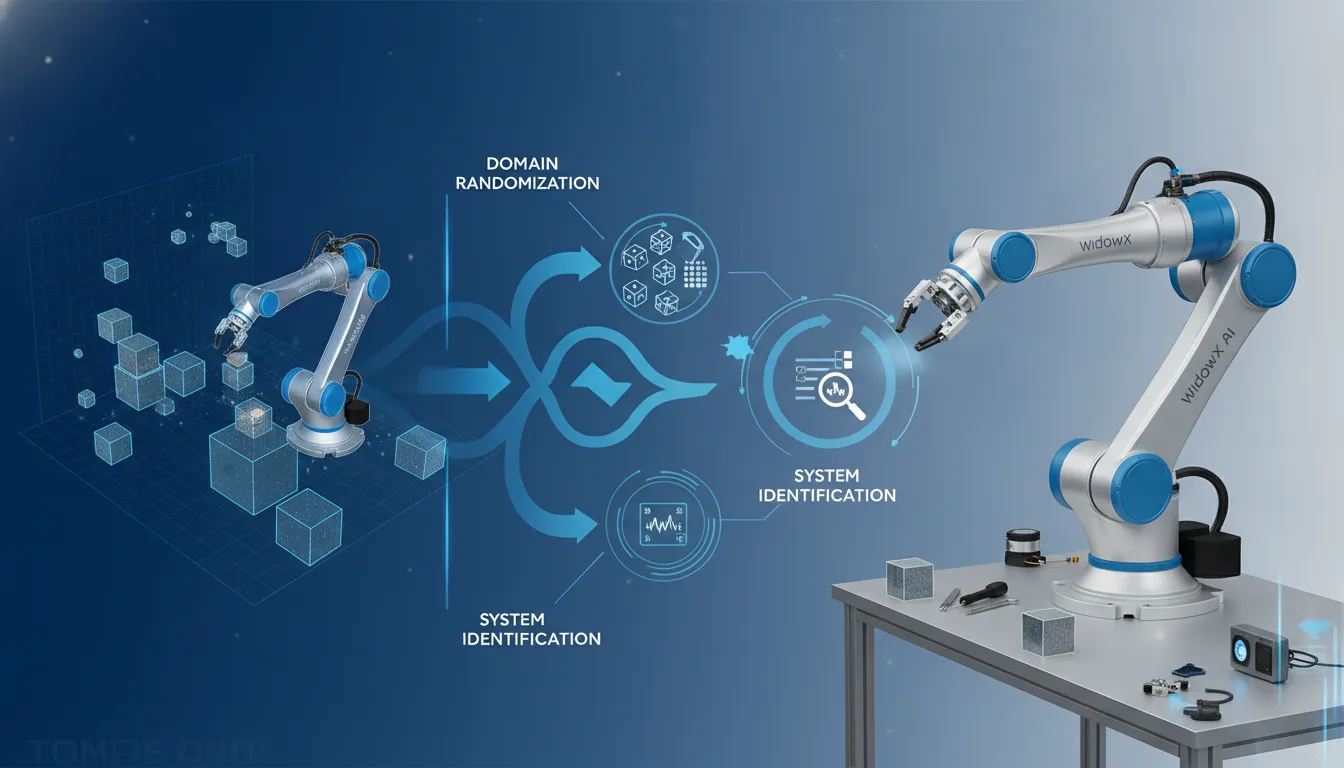
Choosing the right simulation environment directly affects how your team manages the reality gap. MuJoCo, Isaac Sim, and Gazebo each offer distinct strengths. MuJoCo excels at fast, contact-rich physics for locomotion and manipulation. Isaac Sim provides photorealistic rendering critical for visuomotor policy training. Gazebo integrates natively with ROS 2 for teams already invested in the Robot Operating System ecosystem. According to the National Science Foundation, simulation-based analysis of robot dynamics and forces remains a cornerstone of modern robotics research. The correct choice depends on which aspects of the gap your team needs to minimize first.
Closing the gap with well-characterized hardware
Hardware that matches its simulation model reduces transfer friction significantly. Trossen Robotics platforms use standardized actuators with published specifications for torque limits, latency, and positional accuracy. When the simulation model accurately reflects real hardware constraints, the resulting policy generalizes without extensive re-tuning. This is the foundation of a repeatable sim-to-real workflow: simulation fidelity is bounded by how well the hardware is characterized.
How Do You Close the Sim-to-Real Gap?
Bridging the gap requires a combination of algorithmic techniques and physical calibration. Researchers apply three primary strategies, often in combination: domain randomization, system identification, and domain adaptation.
Domain randomization
The most widely adopted technique introduces randomized variation across every simulation parameter during training: mass, friction, lighting, texture, joint damping, and sensor noise. The policy learns to operate across this distribution rather than memorizing a single configuration. NVIDIA's AutoMate system demonstrated this approach with an 84.5% zero-shot success rate on complex assembly tasks after training with extensive randomization. The key is calibrating the randomization range: too narrow and the policy overfits to the simulator; too wide and it learns behaviors too conservative to complete the task.
System identification
Where domain randomization broadens the training distribution, system identification tightens the simulation model itself. Engineers measure real hardware properties including joint stiffness, friction coefficients, motor time constants, and mass distributions, then adjust the simulator to match. Trossen Robotics supports this process by providing precise hardware specifications and calibration interfaces that export real-world actuator data.
The Sim2Real2Sim loop extends this concept into a closed feedback cycle. The team builds an initial simulation, trains a policy, deploys it to hardware, logs failure modes, and uses those observations to refine the simulation model. Research supported by the National Science Foundation validates this iterative approach for improving model accuracy over successive cycles.
Domain adaptation
When visual discrepancies dominate, domain adaptation aligns feature representations between simulated and real sensor streams. Rather than requiring the policy to interpret raw pixels that differ between domains, adaptation layers learn a shared feature space. Decoupled architectures separate perception from control, allowing each module to be updated independently. This is particularly valuable when deploying a perception stack trained on synthetic data to a real camera with different optics, sensor noise profiles, or mounting positions. The same decoupling principle applies to teleoperation-driven data collection, where demonstration quality directly impacts downstream policy performance.
Building a Simulation-to-Hardware Pipeline
A structured pipeline transforms sim-to-real transfer from an experimental exercise into a repeatable engineering process. The following six-step framework provides a template for teams deploying physical AI systems.
- Model your robot in simulation.
Export a URDF or equivalent kinematic model from your hardware specifications. Ensure joint limits, torque curves, and sensor mounting transforms match the physical system. Trossen platforms ship with ready-to-use URDF files for MuJoCo, Isaac Sim, and Gazebo, eliminating the most common source of model mismatch.
- Design the training environment.
Build a task-specific scene in your chosen simulator. Include task-relevant objects, surface materials, and lighting conditions that approximate the deployment environment. Use domain randomization across object positions, textures, and physics parameters.
- Train and validate the policy.
Run reinforcement learning or imitation learning within the simulation. Monitor for reward hacking behaviors that exploit simulation inaccuracies rather than learning genuine task competence.
- Perform zero-shot hardware transfer.
Deploy the trained policy to physical hardware without modification. Measure task completion rate, trajectory smoothness, and force profiles. The gap between simulation and real-world performance quantifies your current reality gap.
- Iterate through Sim2Real2Sim.
Log failure modes from hardware deployment, identify systematic discrepancies (friction too low, torque limits incorrect, perception errors), update the simulation, and retrain. Each cycle narrows the gap.
Deploy with monitoring.
Run the final policy on hardware with continuous logging. Track success rate, recovery behavior, and degradation over time. Use
infrastructure for robotic data pipelines
to feed production observations back into simulation refinement.
The Role of High-Quality Data in Sim-to-Real Transfer
Data quality determines the upper bound of sim-to-real transfer success. Even the most sophisticated simulation pipeline cannot compensate for poor-quality training data. This is where teleoperation and structured data collection become critical components of the workflow.
Multi-modal sensor recording
Effective sim-to-real training requires synchronized multi-modal data: joint positions, velocities, torques, RGB-D camera streams, and end-effector states. Trossen Robotics platforms support teleoperation-driven data collection that captures all these modalities simultaneously through the Trossen SDK. Each demonstration provides a complete sensor snapshot that the simulation can replicate, reducing the adaptation burden on the trained policy.
Standardized data formats
Modern robotic data pipelines use formats including MCAP, Parquet, and LeRobot V2 to store high-bandwidth sensor data efficiently. The Trossen data pipeline infrastructure converts raw teleoperation logs into these standardized formats automatically, ensuring compatibility with popular training frameworks including LeRobot, OpenPi, and OCTO. Standardized data reduces the friction of moving between simulation training and real-world validation.
How data quality improves transfer success
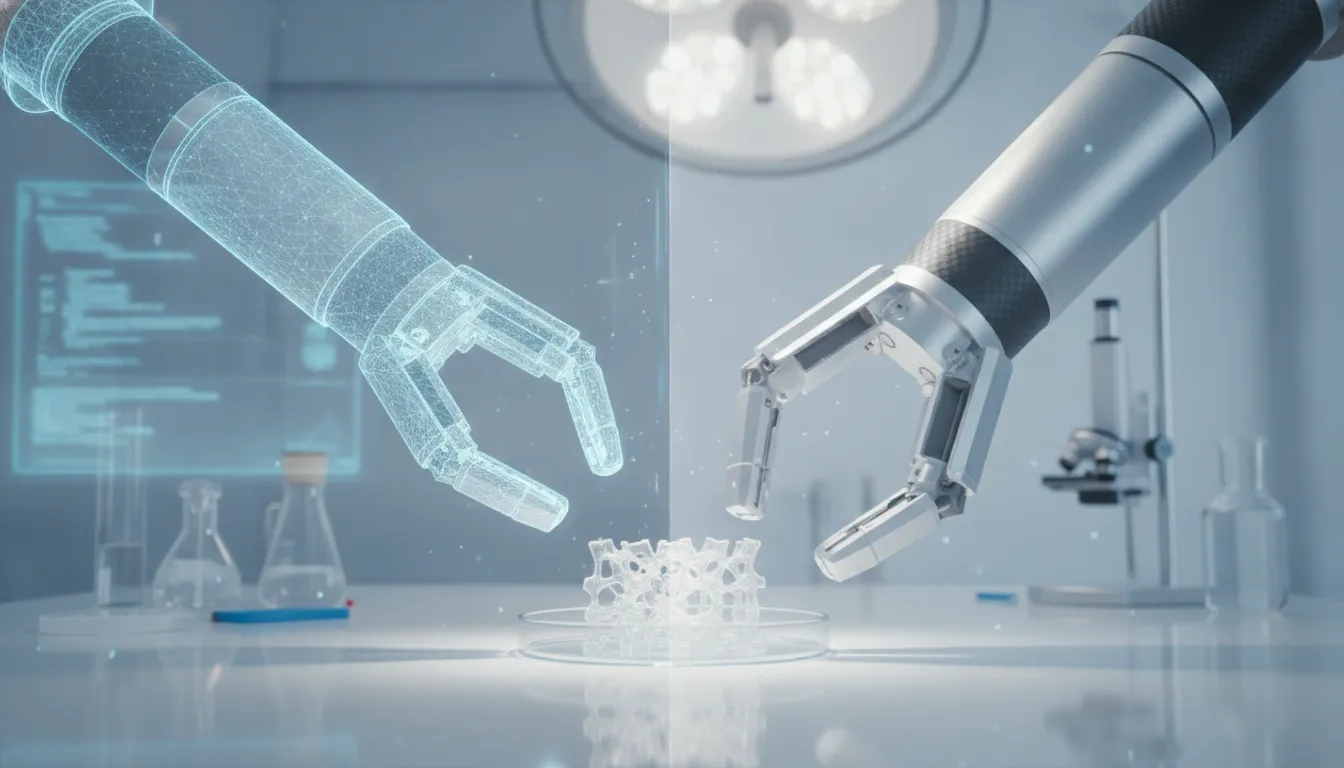
Research confirms that simulation-based training benefits directly from high-fidelity real-world reference data. The National Science Foundation documents how simulation tools help researchers design and analyze robot models before committing to hardware. When teleoperation demos are collected with consistent methodology across camera positions, lighting conditions, and task variations, the resulting policy generalizes more reliably. Modular hardware that maintains consistent sensor positioning across sessions reduces the perceptual domain gap. Allowing the simulation to focus on physics discrepancies rather than also compensating for variable data collection conditions.
How to Evaluate Policies on Real Hardware
Real hardware evaluation introduces constraints that simulation cannot replicate: hardware wear, thermal effects, stochastic contact events, and the cost of failure. A structured evaluation protocol protects your hardware investment while generating actionable data for simulation refinement.
Zero-shot transfer testing
The first hardware deployment should be a controlled zero-shot evaluation. Run the simulation-trained policy on the physical system without any real-world fine-tuning. Measure task completion rate, trajectory smoothness, contact forces, and recovery behavior. A large performance drop between simulation and reality indicates which dimensions of the gap need attention. Trossen's modular design supports safe zero-shot testing by allowing quick end-effector swaps and configurable torque limits that prevent damage during unexpected behaviors.
Iterative refinement with Sim2Real2Sim
Each hardware evaluation generates data that should flow back into the simulation. Tools like RialTo automate parts of this cycle by constructing digital twins from real-world scans and generating training variations. Recent evaluations showed RialTo improving policy robustness by over 67 percent through targeted simulation augmentation based on real failure modes. This closed-loop approach systematically reduces the gap with each iteration, replacing ad-hoc debugging with a measurable convergence process.
Hardware success metrics
Define success beyond binary task completion. Track trajectory smoothness (jerk magnitude), peak contact forces, recovery time from errors, and variance across repeated trials. A policy that completes the task with high jerk or inconsistent force profiles may still fail in production. These metrics also guide simulation refinement: if hardware trajectories exhibit higher-frequency oscillations than simulation predicts, joint damping or control loop latency in the simulation model needs adjustment. Robotic data pipeline infrastructure that captures these metrics enables systematic comparison between simulated and real performance.
When hardware evaluation is mandatory
Certain tasks resist accurate simulation regardless of model fidelity. Deformable object manipulation (cables, fabrics, soft goods), fluid interactions, and tasks involving environmental debris all introduce physics that current simulators approximate poorly. For these domains, hardware evaluation provides signal that simulation cannot. A practical strategy is to use simulation for bulk training and policy exploration, then reserve hardware time for targeted validation and fine-tuning on the most simulation-resistant subtasks.
Real-to-Sim-to-Real and the Rise of Digital Twins
The traditional sim-to-real workflow starts in simulation and moves to hardware. Real-to-Sim-to-Real inverts this approach: the team begins with the physical environment. Creates a digital twin through 3D scanning, trains in simulation, and deploys back to the same physical scene. This cycle tightens the coupling between simulation and reality because the digital twin is built from the actual deployment environment rather than an idealized model.
Digital twins from real-world scans
Systems like RialTo demonstrate this approach in practice. A user scans a physical scene using a standard smartphone, and the scan generates a digital twin simulation automatically. The policy trains in this twin environment, which already matches the visual geometry and object arrangement of the real scene. This eliminates the perceptual gap for static elements and focuses the remaining sim-to-real challenge on physics and dynamics. Trossen platforms integrate with this workflow through modular hardware with known geometric and inertial properties, simplifying the digital twin creation process.
Workflow comparison
Workflow | Data Requirements | Primary Application | Transfer Outcome |
Sim-to-Real | Pure synthetic data | General skill acquisition | Moderate zero-shot transfer |
Real-to-Sim-to-Real | Scene scan + short demos | Environment-specific tasks | High scene-specific robustness |
Sim2Real2Sim | Iterative real-world logs | Physics model refinement | Progressive accuracy improvement |
Success in sim-to-real robotics depends on how closely the simulation mirrors the physical deployment environment. Digital twins built from real scans achieve the closest alignment because they start from ground truth rather than an idealized model.
Frequently Asked Questions
What is the sim-to-real gap in robotics?
The sim-to-real gap is the performance discrepancy that occurs when a robot policy trained in simulation is deployed on physical hardware. It arises from unavoidable differences in physics modeling, visual rendering, and actuator dynamics between simulated and real environments. According to published research, these differences can substantially reduce task success rates after transfer.
How can I close the reality gap for robot learning?
The most effective approaches combine domain randomization, system identification, and iterative Sim2Real2Sim loops. Domain randomization trains the policy across varied simulation conditions. System identification measures real hardware properties and adjusts the simulation to match. The Sim2Real2Sim cycle deploys policies to hardware, logs failures, and refines the simulation based on real observations. Each technique addresses a different aspect of the gap.
What is the Sim2Real2Sim loop?
Sim2Real2Sim is an iterative process that alternates between simulation training and hardware evaluation. The policy trains in simulation, deploys to real hardware, and the observed failure modes inform simulation improvements. This cycle repeats until the policy achieves acceptable real-world performance. NSF-supported research on this closed-loop strategy demonstrates measurable improvements in model accuracy with each iteration.
How does domain randomization improve sim-to-real transfer?
Domain randomization varies simulation parameters including mass, friction, lighting, and textures during training. The policy learns to operate across this distribution rather than memorizing a fixed configuration, making it robust to the variations it will encounter on real hardware. NVIDIA's AutoMate system achieved an 84.5% zero-shot success rate on complex assembly using extensive domain randomization.
What hardware is best for sim-to-real robotics research?
Hardware with well-characterized dynamics, published specifications, and modular design minimizes the sim-to-real gap. Platforms that provide ready-to-use simulation models, teleoperation interfaces, and standardized data collection pipelines reduce the engineering overhead of building and maintaining accurate simulation models. Trossen Robotics platforms are designed specifically for this workflow, with comprehensive simulation support and consistent hardware specifications.
Ready to Build Your Sim-to-Real Pipeline?
Trossen Robotics provides the modular hardware, simulation models, and data collection infrastructure that make sim-to-real workflows practical and repeatable. Our platforms ship with ready-to-use URDF models for MuJoCo, Isaac Sim, and Gazebo, along with the Trossen SDK for synchronized multi-modal data capture. Whether you are establishing a new research program or scaling an existing deployment, our engineering team can help you select the right configuration.
Comments