The Physical AI Deployment Blueprint: Pilot to Reality
Updated: Jul 10
The Short Version
Start with the task, not the robot: pick a narrow, repeatable unit of work with clear inputs and outputs.
Score readiness across the seven questions and aim highest in business value, task scope, and measurement.
Set a measurement plan before the pilot: define success at 30, 60, and 90 days with technical, business, and learning metrics.
Build a practical exception plan using human-in-the-loop support, remote teleoperation, or agentic escalation.
Treat the deployment as a data engine: log interventions and failures, not just successes, in a reusable format.
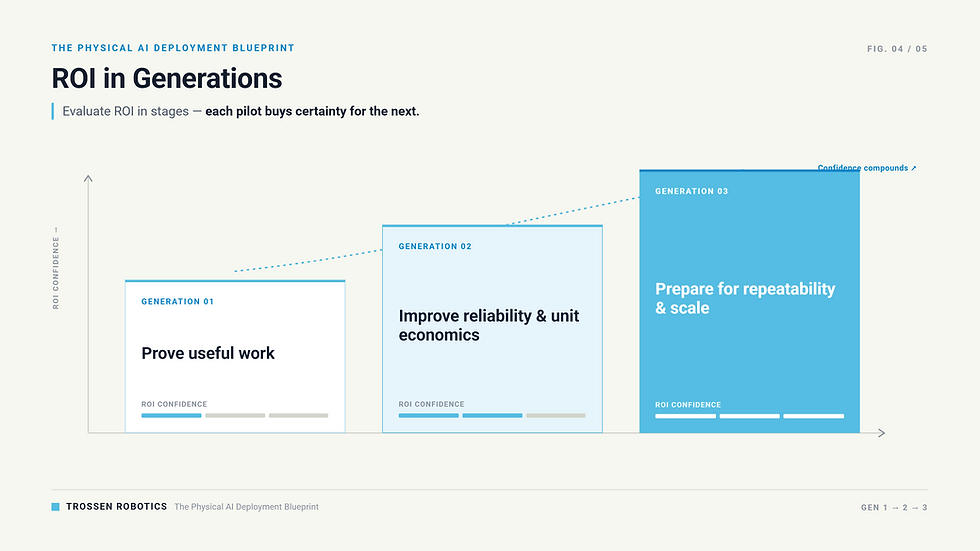
Judge ROI in staged generations, prove useful work, then improve unit economics, then prepare for repeatability.
Coordinate the right partners and contact Trossen Robotics to scope a 2026 or 2027 Physical AI pilot.
Who this is for
Business leaders evaluating early Physical AI adoption
Automation and robotics engineering teams
Operations and plant managers in manufacturing, logistics, and healthcare
Systems integrators and applied-AI partners
Pilot champions and executive sponsors
Researchers and startups building deployment infrastructure

Physical AI Is Entering the "Good Enough to Start" Phase
Physical AI will not enter the market as a fully polished technology. But it is approaching its first serious window for commercial deployment. This article is a practical guide for leaders who want to understand what it takes to deploy Physical AI successfully — not a promise of perfection, but a roadmap for early adoption.
Every major technology eventually shifts its central question. It moves from whether something can work to where it can work first, and what it takes to make it reliable. Physical AI is now entering this phase.
In recent years, discussions around AI-enabled robotics have been driven by significant research breakthroughs and impressive demonstrations. Those advances are crucial. But commercial deployment requires a different standard. Demonstrations showcase possibilities; deployment must prove reliability, safety, and operational fit.
For the right tasks and environments, Physical AI is becoming ready — provided companies take a disciplined approach to evaluation and the surrounding infrastructure. The evolution of autonomous vehicles illustrates this point. Real-world operation was essential for uncovering edge cases and improving the technology, and extensive validation was required to demonstrate safety. Physical AI will likewise encounter unpredictable variation in the real world, which is why it needs well-planned, safety-conscious deployments that foster operational learning.
Business leaders must find a balance between waiting for perfection and rushing in. Early deployment can offer advantages, such as access to better datasets and stronger vendor relationships, while chasing hype can lead to unrealistic expectations.
Companies that thrive will take a pragmatic approach: starting with narrow use cases, clearly defining success, and focusing on iterative improvement. They will integrate human support and traditional systems, and treat initial deployments as learning opportunities.
What Physical AI Means in This Article
Physical AI, as used here, broadly refers to AI-enabled systems that can perceive, reason, decide, or act in the physical world. It includes robotic systems that use artificial intelligence across the workflow: perception, manipulation, planning, coordination, data collection, policy learning, human escalation, and agentic orchestration.
The term should be used broadly, but not carelessly. Physical AI does not require that every part of the system be end-to-end AI. In many successful deployments, it will be paired with traditional automation, deterministic control systems, human operators, remote teleoperation, and software agents.
The useful question is never whether a system is "pure AI." It is whether AI enables the system to do useful physical work that was previously too variable, too manual, too costly, or too difficult to automate.
When Does a Demo Become Ready for Deployment?
A system becomes meaningful when it performs useful work in a real-world environment with measurable outcomes — not when it looks impressive on video. The industry too often treats "demo" and "deployment" as a hard line when they are really a continuum.
The useful question is not whether something is "just a demo," but what it has actually proven, and what still has to be proven before it creates reliable business value. Early systems will not be perfect. They may need remote supervision, human escalation, workflow changes, or tightly bound conditions — and none of that makes them commercially irrelevant.
A demo becomes a deployment candidate when it can answer a few practical questions:
Can it perform a task that matters to the business?
Can the task be measured?
Can the system operate in the conditions where the work actually happens?
Can failure cases be detected, handled, or escalated?
Can humans intervene without breaking the economics?
Can the workflow around the robot be changed enough to support success?
Can the system improve with more data and operational feedback?
The bar to aim for is a minimum viable deployment: not a full rollout or a perfect system, but the smallest real-world deployment that creates measurable value while generating the data and operational feedback needed to improve. That is a different standard than a lab demo, which only has to work once under controlled conditions.
The seven-part readiness rubric later in this article turns these gut-checks into something a team can score. The standard for early Physical AI is not perfection. It is whether the system can do enough useful work, in a bounded setting, with measurable outcomes and manageable exceptions, to justify the next stage of investment.
Start With the Task, Not the Robot
One common mistake in automation is starting with the robot instead of identifying the right task to automate first. Most of the excitement centers on complex, long-horizon automation, but the initial successes will come from simpler, repetitive tasks across industries such as manufacturing, logistics, and healthcare. Tasks such as picking, sorting, and packaging are operational challenges, not science fiction.
Focusing on narrow tasks allows for clearer definitions of success, which makes it easier to measure performance and identify failures. A robot should solve one specific problem effectively, paving the way from demo to deployment.
This strategy emphasizes starting small to learn crucial lessons — such as using real data and understanding ROI — before expanding efforts. Instead of attempting to "automate everything" at once, organizations should automate specific tasks, measure the outcomes, and then build on that success.
What Past Technology Transitions Can Teach Physical AI
No one can yet claim a complete deployment playbook. If the answers were obvious, the market would already have standard vendors, ROI models, datasets, and reference deployments.
But other major technologies offer a clear lesson: technical capability is only the beginning. A technology can work in principle and still fail in practice without the surrounding infrastructure for adoption — trained people, measurable workflows, service models, integration partners, support, and a clear economic case.
Early electricity did not transform manufacturing simply because motors existed. Factories had to be redesigned around it. Computing did not deliver broad productivity gains until organizations rebuilt their processes around it. Paul David's comparison of electrification and computing remains useful precisely because it shows how long transformative technologies can take to produce visible gains as organizations redesign around them.[1]
Physical AI will be no different. The robot is not the deployment, the model is not the deployment, and the demo is not the deployment. The deployment is the whole system — and that is why the first serious pilots should be designed as learning systems.
That reframes readiness as having two dimensions:
Technical readiness asks whether the system can perform the task.
Adoption readiness asks whether the customer can actually use it: install it, maintain it, diagnose failures, absorb interruptions, and economically survive human escalation.
Several public frameworks help here. The GAO Technology Readiness Assessment Guide supports evidence-based maturity assessment rather than vendor optimism.[2] DOE's Adoption Readiness Levels framework adds that commercialization risk also includes market, ecosystem, regulatory, integration, and adoption factors.[3] And because Physical AI carries risks specific to AI systems, NIST's AI Risk Management Framework offers a structured way to govern those risks rather than leaving safety to be sorted out after deployment.[4]
Many of those answers only appear in real operation, which is why early pilots matter. A pilot is not just a test of existing capability but a way to discover what capability is actually required. Unlike software-only AI, Physical AI learns from physical interaction: video, depth, force, robot state, demonstrations, teleoperation corrections, outcomes, and exception logs.
The field is still learning what "good data" means for any given task, robot, and environment. That knowledge will come from pilots, not theory. Open X-Embodiment, which aggregates real robot trajectories across many embodiments, and DROID, which collected tens of thousands of in-the-wild manipulation demonstrations, both point to the same lesson: robot learning improves with larger, more diverse, more realistic embodied datasets.[5][6]
The first serious deployments will define many of the data practices that later become standard. In that sense, early customers are not just adopting Physical AI. They are helping teach the industry how to deploy it.
The Physical AI Deployment Blueprint
Because Physical AI is still emerging, the goal of a first deployment should not be to eliminate every unknown. It should be about identifying the right unknowns, reducing them in the right order, and creating a practical path from controlled demonstration to measurable business value.
That requires a different mindset than traditional procurement. A mature automation project often begins with a known specification, suppliers, integration practices, and performance expectations. In Physical AI, the customer, technology partner, integrator, and model provider are frequently still discovering what the final deployment architecture should look like. That is not a reason to avoid the technology. It is a reason to structure the process correctly.
A strong Physical AI deployment plan should answer seven questions:
Is the business problem worth solving?
Is the task narrow enough to start?
Can success be measured?
Can the system perform useful work with manageable exceptions?
Can the necessary data be collected?
Can the customer and partners support the deployment?
Is there a credible path from pilot to broader adoption?
These questions are the scored version of the earlier demo-readiness gut-check, and they form the basis of a practical deployment rubric. Its purpose is not to generate a perfect answer but to help leaders decide whether an application is ready to explore, what risks need to be reduced, and what the next milestone should prove.

1. Business Value: Is the Problem Worth Solving?
The first question is not technical but economic and operational. Before asking whether a robot can perform a task, leaders should ask whether the task matters enough to justify the effort — because Physical AI should be applied to problems where improvement creates measurable value.
That value may come from labor savings, throughput, quality, safety, consistency, uptime, staffing resilience, ergonomics, data generation, or unlocking capacity the organization cannot otherwise access. A good first application does not need to transform the entire business, but it should be important enough that solving it matters.
Questions to ask:
What operational pain does this task create today, and what does it cost to do it manually or badly?
Would the improvement create measurable value within a single site, line, lab, or workcell?
Is this a real operational need, or is it being chosen because it looks impressive?
2. Task Scope: Is the First Version Narrow Enough?
Physical AI should begin with a task that is narrow enough to learn from. The first deployment should not attempt to automate an entire job, department, or workflow. It should isolate a specific unit of work that can be observed, measured, repeated, and improved.
This is where many organizations make the wrong choice: starting with the future state rather than the first step. They imagine the fully autonomous system they eventually want, rather than identifying the smallest meaningful task that could begin generating value and learning.
Picture a contract manufacturer that wants robots to assemble mixed-part kits for its assembly line. The tempting first project is the entire kitting cell: dozens of part numbers, bins restocked at random, trays that change by customer, and people moving through the workspace all shift. A project like that touches everything at once, so when it stumbles, no one can say whether the culprit is perception, grasping, the shifting layout, or the parts themselves.
A narrower first version can be running and producing measurable output in a matter of weeks: one high-running kit, a fixed set of parts presented in consistent bins, the robot placing each piece into a jig that holds it in a known spot. Every failure it throws points at a single, fixable cause. The broad version is still the eventual goal. The narrow one is how you earn your way there.
A narrow task reduces risk by reducing the number of objects, environments, behaviors, handoffs, exceptions, integrations, and assumptions that must be solved at once. It gives the team a realistic way to understand what the robot must perceive, what it must manipulate, and what success actually looks like.
Can the task be described in one or two sentences, with clear inputs and outputs?
Is the workspace constrained and the objects and materials reasonably consistent?
Can the task be separated from the larger workflow?
Could the first deployment succeed without solving every adjacent problem?
3. Measurement: Can Success Be Defined?
A Physical AI pilot should never begin without a measurement plan, because if success is not defined, the pilot will drift. Technical teams may optimize for model performance while business teams care about throughput, operators care about downtime, executives care about ROI, and safety teams care about incident reduction. Without shared metrics, the same pilot can look like a success to one group and a failure to another.
The best pilots define success at multiple levels:
Technical metrics: task success rate, perception reliability, cycle time, intervention rate, uptime.
Business metrics: labor hours offset, output per hour, scrap reduction, quality improvement, cost per completed task, payback period.
Learning metrics: for an emerging technology, one of the most valuable outputs of a pilot is not the completed work itself but the knowledge gained about the task, the data, the failure modes, the workflow, and the path to the next stage.
Questions to ask:
What does success look like after 30, 60, or 90 days?
What task success rate and cycle time would justify the next stage?
How much human intervention is acceptable?
What data will be collected, and what decision will the pilot enable?
4. Exception Handling: Can Failure Be Managed?
Early Physical AI systems will encounter exceptions, and that should be expected. The important question is not whether the system will fail, but whether failures can be detected, contained, escalated, and resolved in a way that preserves both safety and economics.
This is where many early deployment strategies need to mature. A robot does not have to be perfectly autonomous on day one to be useful, but it does need a practical plan for what happens when it gets stuck. That might be a local operator, remote teleoperation, or an agentic software workflow that pauses the task, requests assistance, logs the exception, and routes the work to a human.
Human-in-the-loop support should not automatically be read as failure. For early deployments, it may be the very mechanism that allows useful work to begin while the system continues to improve. Plus One Robotics' human-in-the-loop automation materials offer a useful commercial example of remote supervisors stepping in to resolve robotic production exceptions.[7]
What are the most likely failure modes, and can the system detect when it is stuck?
Can the task fail safely, and can the workflow continue if the robot pauses?
Who intervenes when the system needs help, and can it happen remotely?
How often can intervention occur before the economics break?
5. Data Readiness: Can the Pilot Generate the Right Learning?
Physical AI differs from many prior technology transitions because the deployment itself can become a data engine. A robot operating in the real world can generate demonstrations, video, depth data, force information, robot state, action trajectories, task outcomes, exception logs, operator corrections, and environmental context. These inputs can serve as the foundation for better models, better workflows, and better future deployments.
But as the earlier discussion of embodied data noted, the field is still learning what "good data" looks like for any given task. A pilot should therefore not only perform work; it should help discover what data matters. That means the data plan has to be intentional from the start rather than an afterthought.
What data will the system collect, and what sensors are needed?
Are human interventions and failed attempts logged, not just successes?
Are demonstrations stored in a reusable format that can improve future models?
Who owns the data, and how are privacy and confidentiality handled?
6. Organizational Readiness: Is the Customer Ready to Learn?
A Physical AI pilot is not something a vendor does to a customer. It is something a customer and partner build together. The customer must provide access to the real operating context: the task, the environment, the objects, the process constraints, the staff, the safety requirements, the economics, and the definition of value. Without that engagement, the project becomes a technology demo in search of a business case.
The best pilot customers have internal ownership. They assign a champion, involve operators early, share process data, and are willing to modify the workflow. They understand that the first pilot is not the final deployment, and they remain open to iteration while staying disciplined about milestones. That combination is rare but essential.
Who owns the pilot internally, and is there executive sponsorship?
Are operators involved early, and is the team willing to adjust the workflow?
Is there a realistic budget for iteration?
Does the organization treat the pilot as a learning process, with a path to expand?

7. Partner Readiness: Are the Right Capabilities at the Table?
Deploying Physical AI typically requires a range of capabilities, including hardware, models, integration, data collection, safety reviews, remote support, and maintenance. It is not common for one company to cover all these areas. The key is to identify and coordinate the necessary capabilities.
Larger enterprises might hire global consulting firms, while smaller projects could work with local engineering teams, robotics startups, or specialized partners. The right approach depends on the task. For focused projects, a small, skilled team familiar with the physical system, the AI workflow, and the deployment milestones may be sufficient.
What capabilities does this pilot require?
Who owns the hardware, and who owns the model or software layer?
Who handles integration, support, and exception workflows?
Are responsibilities clearly defined?
Deployment Readiness Scorecard
Category | 0 — Not Ready | 1 — Early | 2 — Promising | 3 — Pilot-Ready |
Business Value | No clear value | General interest | Meaningful pain point | Measurable operational impact |
Task Scope | Open-ended | Partially defined | Mostly bounded | Narrow, repeatable, well-defined |
Measurement | No metrics | Informal goals | Some KPIs | Clear technical and business milestones |
Exception Handling | No plan | Human help assumed | Basic escalation path | Measured intervention workflow |
Data Readiness | No data plan | Basic recording | Useful data captured | Reusable data pipeline planned |
Organizational Readiness | No owner | Curious sponsor | Internal champion | Executive support plus operational owner |
Partner Readiness | Unknown | Vendor conversations | Partial team identified | Capabilities and responsibilities mapped |
This is not meant to be a rigid formula, but a conversation tool. A project does not need a perfect score to begin, but low scores reveal where the team should focus before committing to a pilot.
A strong first pilot should probably score highest in three areas: business value, task scope, and measurement. If the task matters, the scope is narrow, and success can be measured, the remaining gaps can often be closed through the right partner structure and milestone plan. If those three areas are weak, the project is likely premature. A high-potential project does not need to be easy; it needs to be learnable.
Do Not Ask One Model to Do Every Job
A practical Physical AI strategy should not begin with the assumption that a single model, robot, or architecture can solve the entire problem. That is rarely how robust technology systems are built.
The better question is what the simplest combination of tools can be to make a task work reliably enough to create value. That question brings Physical AI back into the discipline of good engineering, where the goal is not to maximize novelty but to solve the problem with the right balance of cost, complexity, reliability, flexibility, and time to deployment.
A mechanic does not use one universal tool for every job. A wrench, lift, diagnostic scanner, torque tool, and alignment rack all exist because each solves a different problem better than the others. The same principle applies to Physical AI. The most successful deployments will not be built by forcing one intelligent system to do everything, but by combining the right tools for the task.
This is also how modern AI is becoming more useful in software. The most reliable LLM-based workflows are usually not raw models operating alone. They combine models with tools, retrieval systems, APIs, calculators, hard-coded business logic, routing, verification, human review, and workflow orchestration.
Anthropic's guidance on building effective agents explicitly distinguishes workflows from agents and describes patterns such as prompt chaining, routing, parallelization, orchestrator-worker structures, and evaluator-optimizer loops.[8] OpenAI's function-calling documentation similarly frames tool use as a structured way for models to call external systems and functions rather than relying on the model alone.[9] Physical AI should be approached the same way, with the AI model treated as one part of a broader deployment architecture rather than the entire solution.
The Right Tool for Each Part of the Task
A Physical AI deployment may draw on many different tools and techniques:
fixtures and jigs that make the task more repeatable
cameras and sensors that improve perception
computer-vision systems for detection or inspection
motion planning for predictable movement
learned policies for variable manipulation
reinforcement learning or imitation learning for skill acquisition
force or tactile feedback for contact-rich tasks
linear rails, gantries, or mobile bases to extend reach
AMRs or conveyors to move materials
multi-arm systems for coordinated manipulation
deterministic controls for safety-critical or repetitive actions
remote teleoperation for exceptions
human operators for supervision, judgment, and recovery
software agents for routing, coordination, and escalation
The point is not that every deployment needs all of these, but that Physical AI should be treated as a toolkit. Sometimes the best way to improve robot performance is not a better model but a better fixture. Sometimes the right answer is not reinforcement learning but a camera in a better location. Sometimes the way to reduce complexity is not more autonomy but a workcell redesigned so the robot faces less variation.
Pragmatism matters, because each additional layer adds cost, integration burden, maintenance overhead, and failure modes. A good deployment uses the minimum complexity needed to meet the business goal.
That same logic means Physical AI is not a replacement for traditional automation but an expansion of what automation can address. Conveyors, PLCs, safety systems, machine vision, fixtures, feeders, gantries, AMRs, and industrial controls remain excellent where the task is structured and deterministic, and in many deployments they will handle most of the process.
Physical AI earns its place where the real world introduces variability that rigid automation struggles with: object variation, uncertain poses, flexible materials, inconsistent placement, or tasks that need perception and manipulation together. The best architecture is usually hybrid: deterministic automation for the predictable parts, Physical AI for the parts that require adaptation, humans or remote supervisors for exceptions, and software agents to coordinate the flow. That is not less advanced than full autonomy. It is more deployable.
McKinsey's 2025 AI survey work reinforces the point: value from AI is tied to workflow redesign rather than mere technology insertion, and the survey found that workflow redesign had the biggest effect on whether organizations saw EBIT impact from generative AI.[10]
The Role of Agentic Coordination
Agentic systems are particularly interesting for Physical AI, but they should be used with caution. In the near term, the most practical role for agents may not be direct low-level robot control but coordination across tools, systems, and humans.
An agentic layer could help decide what task should happen next, which robot or workcell should perform it, whether the robot is confident enough to proceed, whether to use a deterministic routine or a learned behavior, whether the task needs human review, whether to call a remote operator, whether an exception should be logged for retraining, and whether the workflow needs to pause, reroute, or escalate.
That kind of coordination is valuable because real deployments involve more than motion. They involve decisions, queues, priorities, exceptions, safety constraints, data capture, human escalation, maintenance events, and business logic.
But agentic coordination should not be confused with unlimited autonomy. In many Physical AI deployments, certain functions should remain deterministic, constrained, verified, or human-approved. Safety-critical decisions, machine interlocks, emergency stops, and tightly specified industrial control logic should not be handed casually to probabilistic systems. A good architecture gives agents the right scope:
Use agents where flexibility, coordination, and context are valuable.
Use deterministic systems where predictability, verification, and safety are required.
Use learned models where variation exceeds what rigid programming can handle.
Keep humans where judgment, oversight, or exception handling is the most reliable path.
Remote Teleoperation Is Infrastructure, Not Failure
Early Physical AI systems will not handle every edge case autonomously, but that should not disqualify them. Remote teleoperation and human-in-the-loop support can be part of the deployment architecture. A robot that completes most of a task autonomously and escalates exceptions efficiently can still create real value, especially if a single remote operator can supervise several systems.
This is how many mature systems already handle exceptions: software systems escalate tickets, manufacturing systems stop for operator intervention, logistics systems route exceptions to human teams, and customer-service systems use automation for routine interactions and humans for the complex cases. Physical AI should be allowed to mature the same way. Human involvement does not automatically mean the system failed. It may simply mean the system has a practical bridge from partial autonomy to useful deployment.
The key is measurement. How often does intervention happen, how long does it take, and what does it cost? Can one operator support multiple robots? Are interventions logged, and do they create data that improves future autonomy? If the economics work, human-in-the-loop support can accelerate deployment rather than delay it.

The Economics of Early Physical AI Adoption
The economics of Physical AI should be treated with discipline, but not with false precision. In a mature automation project, the ROI model can be relatively straightforward. A company can estimate equipment cost, integration cost, labor savings, throughput improvement, maintenance cost, uptime, depreciation, and payback period. The assumptions may not be perfect, but they are usually grounded in known technology, known suppliers, known implementation practices, and known operating environments.
Physical AI is different. Because the market is still emerging, many of the most important assumptions are not fully known at the outset. The team may not yet know the achievable task success rate, the true intervention rate, the required data volume, the level of workflow redesign, the support burden, the maintenance profile, or the path from pilot to production.
That uncertainty does not make ROI irrelevant; it makes ROI staged. The first economic question should not be whether the pilot can prove the full business case immediately, but whether it can reduce enough uncertainty to justify the next stage of investment. That is a more practical way to evaluate early Physical AI.
Judge ROI in Stages, Not All at Once
Business leaders should be careful not to judge an emerging-technology pilot by the economics of a mature deployment. The first version of a Physical AI system may be more expensive, more supervised, slower, and less polished than later generations. It may need engineering support, operator feedback, remote assistance, custom fixtures, or manual intervention. Judged purely as a finished automation product, it can look underwhelming.
That is usually the wrong standard. Early deployments of major technologies often require complementary investment before the full productivity gains appear: organizations have to redesign processes, develop new skills, collect data, build support systems, and learn how to use the technology effectively. Brynjolfsson, Rock, and Syverson's Productivity J-Curve work argues that general-purpose technologies such as AI require complementary intangible investments, which can cause early productivity gains to be understated before later benefits appear.[11] Physical AI will likely follow the same pattern.
So the first pilot should still create measurable value. It should not be a science project with no business connection. But its economic job is broader than immediate savings: it should reduce uncertainty about what task performance, intervention rate, data needs, workflow changes, hardware, support model, and uptime are realistic — and about what the economics would look like at scale.
The cleanest way to hold that discipline is to evaluate Physical AI in generations rather than as a single yes-or-no event.
Generation 1: Prove Useful Work. The first generation should prove that the system can perform useful work in a bounded environment. The economics may be incomplete: the system may require supervision, cycle time may not yet be optimized, and data collection may be a major part of the value. The key question is whether the task is real, measurable, and promising enough to continue.
Generation 2: Improve Reliability and Unit Economics. The second generation uses what the first pilot taught to improve reliability, reduce intervention, simplify the workflow, and refine the support model. Here the ROI model becomes concrete: cost per completed task, supervision ratio, uptime, maintenance burden, quality, throughput, and the conditions required to strengthen the business case.
Generation 3: Prepare for Repeatability. The third generation tests whether the deployment can be repeated across more shifts, workcells, sites, product variations, or operating conditions. The question is whether the system still depends on heroic engineering effort, or whether it is becoming repeatable enough to scale.
Within and across those generations, a strong pilot runs on milestones rather than hope. Each stage should define which assumption is being tested, what evidence will settle it, what performance is acceptable, what cost or timeline boundary applies, and what decision is made at the end. That discipline lets leaders avoid both killing promising projects too early and overfunding ones that do not reduce uncertainty.
Real-options thinking is useful here, because a pilot buys the option to expand later as uncertainty declines. But HBR's "Making Real Options Really Work" cautions that the logic can encourage overinvestment when managers treat uncertainty as pure upside without respecting cost volatility and staged discipline.[12] The right use of an options mindset is not "anything could be valuable someday." It is structured learning under uncertainty.
The ROI Model Should Include More Than Labor Savings
Labor savings matter and, in many cases, will be central to the business case, but they should not be the only part of it. Physical AI can create value in several ways: increased throughput, improved consistency, reduced scrap or rework, reduced ergonomic strain, reduced safety risk, improved uptime, better use of scarce labor, improved process visibility, better data about physical operations, reduced dependence on hard-to-staff roles, increased flexibility across product variants, and faster learning for future automation projects.
Some of these benefits are direct and measurable. Others are strategic and harder to quantify. Both matter.
A company may begin with one use case and discover that the most valuable return is the capability it builds: internal expertise, better process data, a clearer automation strategy, trained operators, stronger partner relationships, and a more realistic understanding of where Physical AI can create value.
That learning compounds. The first deployment teaches the organization how to scope the second, and the second teaches it how to improve the third. Over time, the company gets better at identifying automatable work, designing robot-friendly processes, collecting useful data, and managing human-in-the-loop automation. That capability may ultimately prove more valuable than the first task itself.
The Strategic Return of Being Early
Companies that adopt emerging technologies early can capture advantages that late adopters struggle to replicate. They learn faster, build internal champions, and come to understand the technology's limits. They shape vendor roadmaps, discover hidden process constraints, build proprietary datasets, and identify which use cases are worth pursuing before the market becomes crowded.
But being early only helps if a company is early in the right way. It does not mean chasing hype, automating the hardest task first, assuming the first pilot will be perfect, or ignoring ROI. It means choosing a narrow, meaningful task and using it to build a learning advantage.
The companies that do this well will not simply ask whether the first robot paid for itself. They will ask harder questions: what they learned that competitors do not know yet, what data they collected that will improve future systems, which process changes they discovered, and which internal capabilities they built. They will also ask which risks they reduced, which future deployments are now more realistic, and what it would cost to learn all of this later.
That last question is the important one, because waiting has a cost. A company that delays until Physical AI is fully mature may avoid the messiness of early adoption, but it also delays its own learning curve. By the time the market is obvious, the leading organizations may already hold better datasets, better workflows, better-trained teams, stronger partner relationships, and a clearer view of where the technology creates value.
The safest strategy is not always to wait. Sometimes the safer long-term strategy is to start small, learn early, and scale only when the evidence supports it.
Why the Right Partner Matters
Deploying Physical AI is not only a technology decision. It is also a partner decision. The stack encompasses many elements, including hardware, software, models, sensors, computing power, data handling, safety protocols, workflow design, support services, and integration. A company may have a solid task and a clear business case, yet still face difficulty if the surrounding ecosystem lacks the capacity to support deployment.
The partner landscape for Physical AI is still developing. There is no comprehensive directory of integrators and no universal playbook, which complicates navigation. But this uncertainty also presents an opportunity, because the people building this field are often highly motivated to make initial projects successful.
A crucial lesson from previous technological shifts is that innovation rarely thrives on technical capability alone. It flourishes when the complementary assets are in place: services, support, integration, training, documentation, and operational expertise. As Teece's classic work on profiting from technological innovation shows, value capture often relies on complementary assets and partner choices rather than invention alone.[13] A capable model, robot, or demonstration still requires a practical path to deployment, and that path depends on the right partners.

The Spectrum of Partners
Choosing the right partner hinges on your scale and ambition.
Large consulting and systems-integration firms such as Accenture, Capgemini, and Deloitte are suited to enterprises undertaking broad, multi-site transformation programs.
Smaller engineering firms, automation specialists, and applied-AI teams often serve as a more practical starting point for focused pilots, thanks to lower overhead, faster implementation, and a readiness to engage in first-of-a-kind deployments.
Specialized partners focus on a single aspect — such as models, data management, teleoperation, perception, simulation, hardware, or compute — and these are frequently startups emerging from research groups.
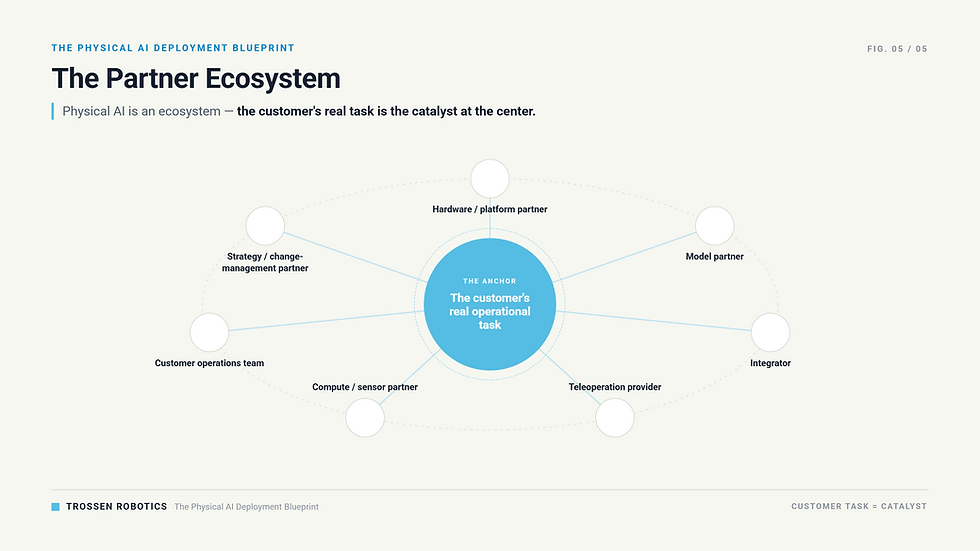
A specific deployment may require several partners simultaneously, reflecting the nature of Physical AI as an ecosystem rather than a single product category.
Hardware and the Full Stack
A successful deployment can involve a wide range of components: hardware, end effectors, sensors, compute, safety measures, data tools, model workflows, teleoperation, motion planning, workcell design, fixtures, training, documentation, support, and integration with existing systems. No single vendor can provide all of it.
A successful deployment usually results from coordinated effort among the customer, hardware providers, software developers, model creators, and integration partners, each contributing in its area of expertise. A common mistake is treating Physical AI solely as a model problem or a robot problem when it is, in fact, a systems problem.
Hardware is where AI meets the real world. Failures in software-only AI can often be reversed. In the physical realm, mechanical design, repairability, documentation, spare-part availability, sensor placement, thermal performance, compute, and support all matter directly. The physical system is the medium through which the model operates. The best platforms make experimentation easy without compromising deployment rigor — enabling easy data collection, sensor integration, policy testing, end-effector swapping, repair, and transitions from research to pilot to scalable deployment.
Trossen's Role in the Physical AI Ecosystem
Trossen Robotics aims to be a key practical layer in the ecosystem, focused on robotic hardware, platform infrastructure, support, and deployment-oriented tools. For more than two decades, Trossen has worked to make robotics accessible to researchers, developers, startups, and commercial teams.
This focus matters more as Physical AI enters early deployment. The market requires more than impressive demonstrations. It needs systems that can be purchased, supported, repaired, modified, documented, and integrated by teams doing real work.
This approach also means working through the complex, early-stage questions with customers: identifying the right tasks, setting realistic performance expectations, determining the appropriate sensors and compute, deciding what can be handled by traditional automation, understanding where humans should stay involved, and identifying what must improve before scaling.
The Customer Is the Catalyst
The most important participant in early deployments is often the customer, not the model provider or the integrator. Emerging markets face a chicken-and-egg problem: providers need real deployments for insights, but customers hesitate until the market matures.
The customer offers what the ecosystem cannot create on its own, including the real workflow, the constraints, and the definition of value. This does not mean risking the business on unproven systems. Instead, companies should select a low-complexity, meaningful task with limited downside and significant learning opportunity. In Physical AI, simplicity is a risk-management strategy. The right partner can help identify, contain, and measure uncertainty, clarify the task, set milestones, and build the customer's capability without fostering dependency.
Early markets mature through collaboration among an ecosystem, not by relying on a single company. The "valley of death" concept highlighted by Manufacturing USA and ITIF underscores the need for partnerships, demonstration environments, and de-risking infrastructure to help emerging technologies advance from proof of concept to commercial use.[14][15] Physical AI is at this stage now. Companies that choose the right partners, start with suitable tasks, and focus on measurable learning will be best positioned to turn early deployments into lasting advantage.
Building the First Wave of Physical AI Deployments
Physical AI is not yet ready to tackle every task, but it is poised for serious exploration. The focus now should not be on waiting for a perfect future system. Instead, we need to identify the right initial applications: specific, measurable, low-complexity tasks where Physical AI can begin making a meaningful impact. This approach will generate the data, insight, and operational experience needed for the next generation of technology.
We will advance in this market not through hype or reckless overreach, and not by pretending every problem has already been solved. We will progress through practical pilot projects with real customers, concrete tasks, measurable outcomes, and genuine learning.
Trossen Robotics is actively seeking organizations interested in exploring Physical AI pilot projects in 2026 and 2027. The ideal partners will not be looking for quick fixes. They will be looking for a structured way to evaluate how Physical AI can add value, determine the goal of the first pilot, identify the data worth collecting, and understand what it takes to move from initial deployment to broader adoption.
If your organization is considering how Physical AI could fit into your operations, we would love to speak with you. The first step is not to purchase a robot. It is to identify the right task.
Contact:
Marc Dostie
Principal Solutions Architect Trossen Robotics marc@trossenrobotics.com
References
Paul A. David, "The Dynamo and the Computer: An Historical Perspective on the Modern Productivity Paradox," *American Economic Review*, 1990. https://www.jstor.org/stable/2006600
U.S. Government Accountability Office, *Technology Readiness Assessment Guide: Best Practices for Evaluating the Readiness of Technology for Use in Acquisition Programs and Projects* (GAO-20-48G), January 2020. https://www.gao.gov/products/gao-20-48g
U.S. Department of Energy, *Adoption Readiness Levels (ARL) Framework*. https://www.energy.gov/technologycommercialization/adoption-readiness-levels-arl-framework
National Institute of Standards and Technology, *AI Risk Management Framework*. https://www.nist.gov/itl/ai-risk-management-framework
Open X-Embodiment Collaboration, "Open X-Embodiment: Robotic Learning Datasets and RT-X Models," 2023. https://robotics-transformer-x.github.io/ (paper: https://arxiv.org/abs/2310.08864)
Alexander Khazatsky et al., "DROID: A Large-Scale In-the-Wild Robot Manipulation Dataset," 2024. https://droid-dataset.github.io/ (paper: https://arxiv.org/abs/2403.12945)
Plus One Robotics, *Human-in-the-Loop Automation*. https://www.plusonerobotics.com/human-in-the-loop
Anthropic, "Building Effective Agents," December 2024. https://www.anthropic.com/research/building-effective-agents
OpenAI, *Function Calling / Tool Use Documentation*. https://developers.openai.com/api/docs/guides/function-calling
McKinsey & Company, *The State of AI: How Organizations Are Rewiring to Capture Value* (March 2025) and *The State of AI* global survey (November 2025). https://www.mckinsey.com/capabilities/quantumblack/our-insights/the-state-of-ai-how-organizations-are-rewiring-to-capture-value and https://www.mckinsey.com/capabilities/quantumblack/our-insights/the-state-of-ai
Erik Brynjolfsson, Daniel Rock, and Chad Syverson, "The Productivity J-Curve: How Intangibles Complement General Purpose Technologies," *American Economic Journal: Macroeconomics*, 2021. https://www.aeaweb.org/articles?id=10.1257/mac.20180386
Alexander B. van Putten and Ian C. MacMillan, "Making Real Options Really Work," *Harvard Business Review*, December 2004. https://hbr.org/2004/12/making-real-options-really-work
David J. Teece, "Profiting from Technological Innovation: Implications for Integration, Collaboration, Licensing and Public Policy," *Research Policy*, 1986. https://ideas.repec.org/a/eee/respol/v15y1986i6p285-305.html
Manufacturing USA (DoD ManTech), "Manufacturing USA." https://www.dodmantech.mil/Manufacturing-Collaborations/Manufacturing-USA/
Information Technology & Innovation Foundation, *Across the "Second Valley of Death": Designing Successful Energy Demonstration Projects*, 2017. https://itif.org/publications/2017/07/26/across-second-valley-death-designing-successful-energy-demonstration/
_Learn more about Trossen Robotics and Trossen SDK for your deployment._
Frequently Asked Questions
What is a Physical AI Deployment Blueprint?
It is a practical roadmap for moving Physical AI from controlled demonstration to measurable business value by identifying the right unknowns, reducing them in the right order, and answering seven deployment questions covering business value, task scope, measurement, exceptions, data, organization, and partners.
What does Physical AI mean in this article?
Physical AI broadly refers to AI-enabled systems that perceive, reason, decide, or act in the physical world, including robotic systems that use AI across perception, manipulation, planning, coordination, data collection, policy learning, human escalation, and agentic orchestration. It does not require every part to be end-to-end AI.
When does a demo become ready for deployment?
A demo becomes a candidate when it can perform a task that matters, be measured, operate in real conditions, detect and escalate failures, allow human intervention without breaking the economics, and improve with data. The bar to aim for is a minimum viable deployment, not a perfect system.
Is human-in-the-loop support a sign of failure?
No. Remote teleoperation and human-in-the-loop support are infrastructure, not failure, and can be the mechanism that allows useful work to begin while the system improves, especially if a single remote operator can supervise several systems. The key is measuring how often, how long, and at what cost intervention happens.
How should ROI for early Physical AI be evaluated?
Judge ROI in stages rather than all at once. Generation 1 proves useful work, Generation 2 improves reliability and unit economics, and Generation 3 prepares for repeatability. The first economic question is whether the pilot reduces enough uncertainty to justify the next stage of investment.
What is Trossen Robotics' role in Physical AI deployment?
Trossen Robotics aims to be a key practical layer in the ecosystem, focused on robotic hardware, platform infrastructure, support, and deployment-oriented tools. For more than two decades, Trossen has worked to make robotics accessible to researchers, developers, startups, and commercial teams.
Should one model handle every part of the task?
No. Physical AI should be treated as a toolkit, combining fixtures, sensors, motion planning, learned policies, deterministic controls, remote teleoperation, humans, and software agents. The best architecture is usually hybrid, using the minimum complexity needed to meet the business goal.
Comments