What Is Physical AI? A Practical Guide to the Robotics Stack
Updated: Sep 15
Physical AI is artificial intelligence that perceives, reasons about, and acts in the physical world through machines such as robots. Unlike software-only AI, it must connect models to sensors, actuators, real-time control, safety systems, and a continuous stream of real-world data. A useful physical AI system is therefore not just a model or a robot. It is a complete learning loop that turns physical interaction into better behavior.
This guide explains the physical AI stack from the perspective of the teams building it: research labs, enterprise R&D groups, robotics startups, and data-collection operations. It focuses on what each layer does, how the layers connect, and what must work before a learned behavior can move from a controlled demonstration into repeatable operation.
What does physical AI mean?
Physical AI refers to AI-enabled systems that can sense their surroundings, interpret a task or goal, decide what to do, and produce a physical action. The term often overlaps with embodied AI, which emphasizes that intelligence is shaped by a system's body, sensors, actions, and interaction with an environment.
A manipulation system, for example, might use cameras to observe a workspace, a learned policy to select an action, and a robotic arm to grasp or move an object. The consequences of that action become new observations. That repeated cycle of observation, decision, action, and feedback is what makes physical AI different from an AI system that only generates a text or image response.
Not every component needs to be learned. Practical systems often combine machine learning with conventional motion planning, deterministic controls, safety limits, human supervision, and teleoperation. The important distinction is that AI helps the machine handle some part of the variability, perception, planning, or adaptation required to perform physical work.
How is physical AI different from software AI and traditional robotics?
The difference is not simply that physical AI uses a robot. It is that actions have real consequences, observations arrive through imperfect sensors, and performance depends on an entire physical system. Latency, mechanical tolerances, lighting, camera placement, object variation, and recovery behavior can matter as much as model architecture.
Dimension | Software AI | Traditional robotics | Physical AI |
Primary environment | Digital information | Structured physical environments | Variable physical environments |
Typical input | Text, images, database records | Programmed coordinates and sensor signals | Video, depth, force, joint state, language, and context |
Typical output | A prediction or generated response | A predefined motion or sequence | An action selected from learned and programmed behavior |
How behavior improves | More digital training data and model updates | Programming and process engineering | Demonstrations, real-world episodes, evaluation, and retraining |
Core challenge | Accuracy and relevance | Repeatability in a controlled process | Generalization without compromising safety or reliability |
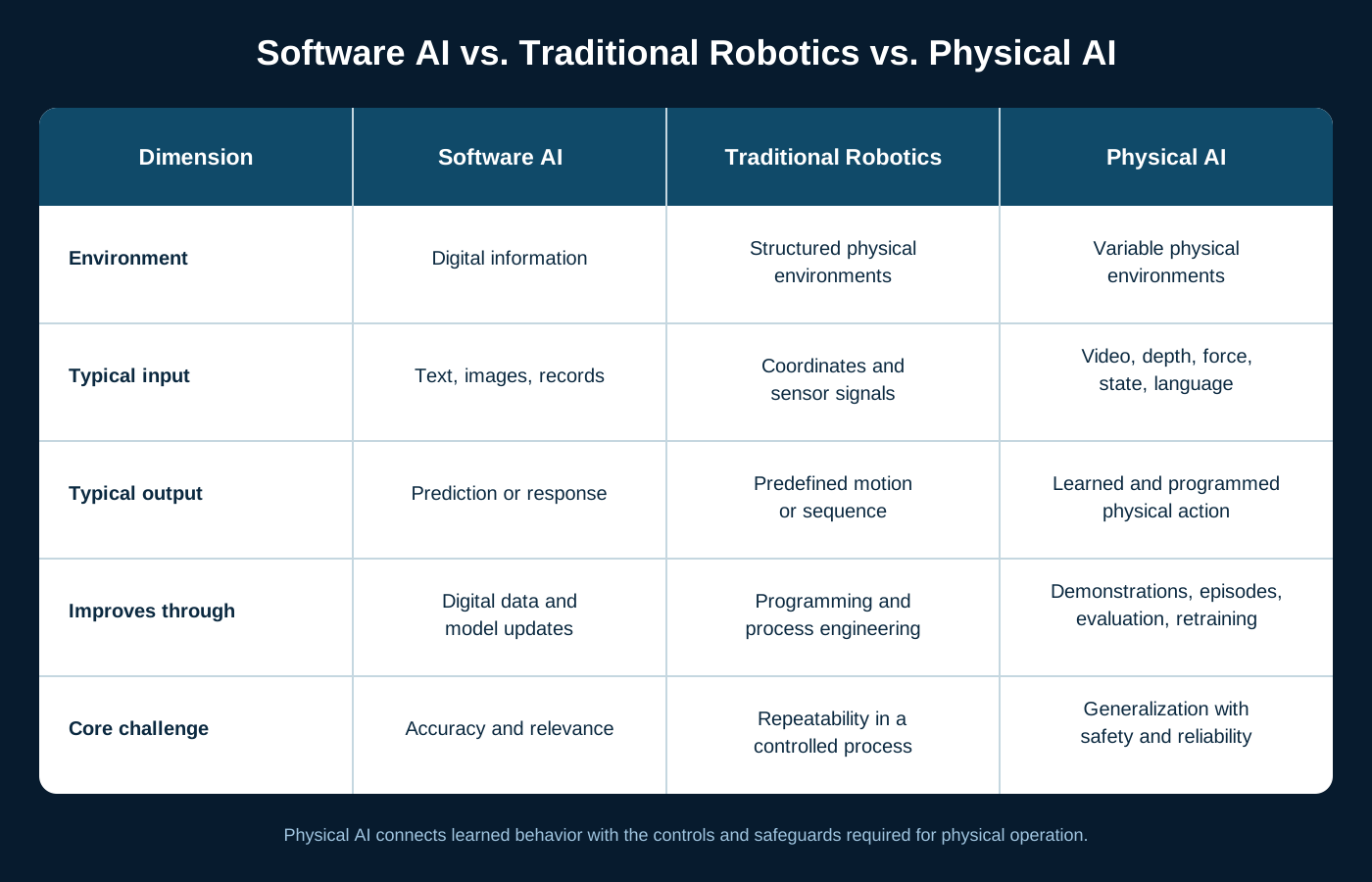
Physical AI combines learned behavior with the controls and safeguards required for real-world operation.
Traditional robotics remains essential. It excels when a process can be precisely specified and the environment can be tightly controlled. Physical AI becomes valuable when variation is too broad or expensive to encode one rule at a time, but the system still needs the controls and safeguards that make physical operation dependable.
The practical physical AI stack
The physical AI stack is a connected set of hardware, data, learning, evaluation, and deployment layers. Weakness in any layer can limit the entire system. A high-performing model cannot compensate for inconsistent camera placement, unreliable timestamps, or an actuator that cannot execute the required motion.
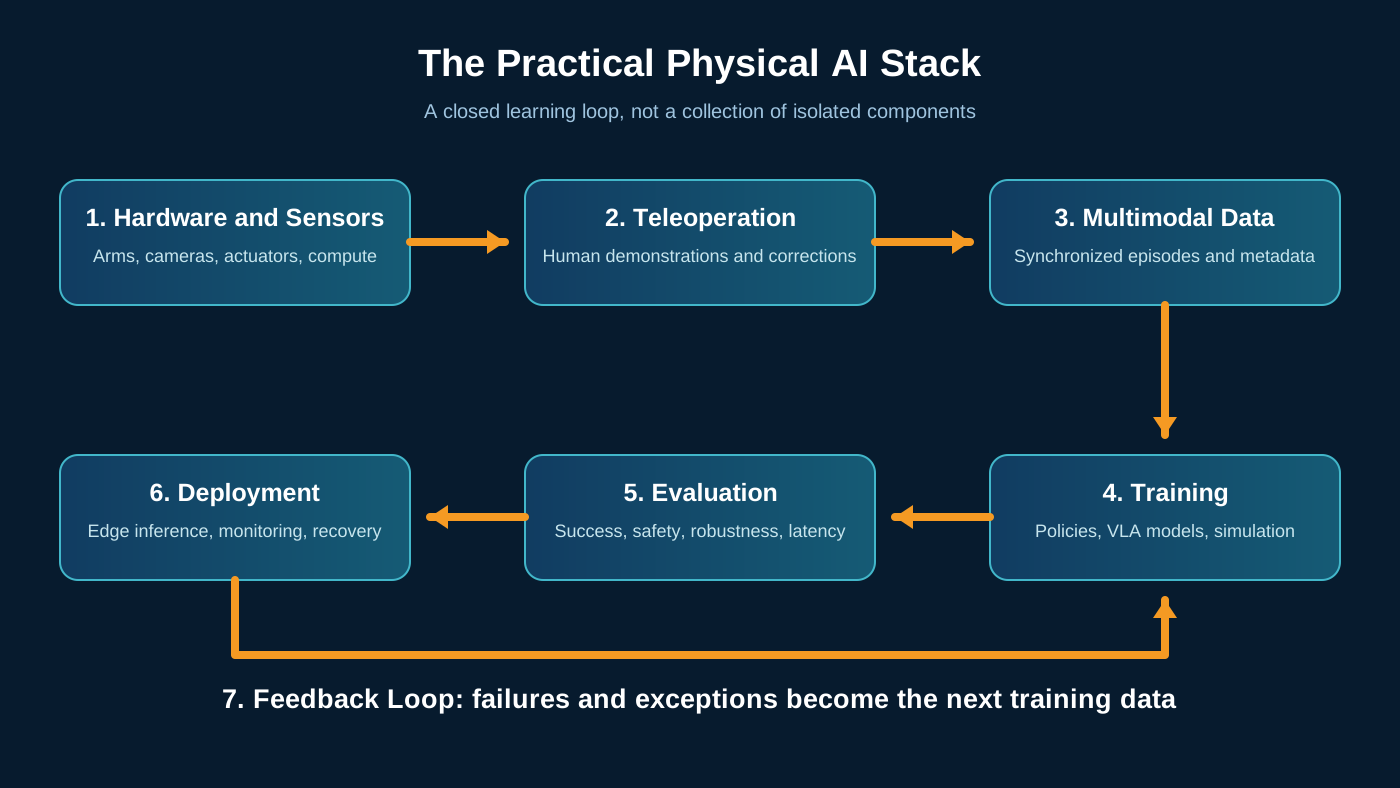
The practical physical AI stack is a closed loop. Deployment results and exceptions become inputs for the next round of data collection and training.
1. Robot hardware, sensors, and real-time control
The hardware layer gives intelligence a body. It includes manipulators or mobile platforms, actuators, grippers, cameras, depth sensors, force or torque sensing, embedded controllers, and compute. The design of that body determines what the system can observe and what actions it can physically perform.
For robot learning, consistency matters. A platform must produce reliable control signals and synchronized observations across many repeated episodes. It should also be serviceable and documented, since small mechanical or configuration changes can shift the data distribution seen by a model. Teams selecting a platform can use Trossen's AI hardware selection guide to compare practical research configurations.
2. Teleoperation and human demonstrations
Teleoperation lets a person directly guide a robot through a task. It is one of the most practical ways to collect demonstrations, correct failed behavior, and define what a successful action looks like. In leader-follower manipulation systems, the operator moves a leader arm while the follower arm reproduces the motion and records the resulting trajectory.
A useful teleoperation setup must be comfortable enough for repeatable work and precise enough to capture the behavior the model needs. Operator technique, task instructions, reset procedures, and camera visibility all affect dataset quality. Teleoperation is not merely a control interface. It is part of the data-production system.
3. Multimodal data capture and management
Robot learning datasets contain more than video. A single episode can combine camera streams, depth, joint positions, commanded actions, timestamps, task labels, success outcomes, and operator notes. These signals must stay synchronized and retain enough context for training and later diagnosis.
At small scale, a team may collect episodes from one robot and inspect them manually. At larger scale, it needs structured storage, automated checks, dataset versioning, consistent metadata, and a way to identify failed or low-quality episodes. The Trossen Data Collection SDK is designed to help teams capture, visualize, convert, and manage robotic data without rebuilding the pipeline around every experiment.
Explore the Trossen Data Collection SDK to build a more repeatable path from demonstration to trainable dataset.
4. Training, simulation, and policy development
The training layer turns demonstrations and interaction data into a policy that maps observations and goals to actions. Depending on the task, teams may use imitation learning, diffusion policies, reinforcement learning, or vision-language-action models. Simulation can supplement real-world data, support rapid testing, and expose the policy to variations that are difficult or risky to reproduce physically.
Framework compatibility affects how quickly a team can move. Open tools and standard data formats reduce the effort needed to compare methods or reuse datasets. Trossen AI platforms support workflows around tools such as LeRobot and OpenPi. For a concrete example, see how Trossen AI arms integrate with OpenPi for VLA model workflows.
5. Evaluation and failure analysis
A model that succeeds in a training video is not necessarily ready for operation. Evaluation must test the complete system across realistic conditions: object placement, lighting, clutter, starting state, operator variation, task duration, latency, and recoverable failures. Teams should define success before collecting data so that every episode can contribute to measurable learning.
Useful evaluation goes beyond an average success rate. It asks where the system fails, whether failure is detectable, how safely it stops, and what data would reduce the next uncertainty. A small set of well-labeled failure modes often tells a team more than a large collection of unstructured attempts.
6. Deployment, monitoring, and feedback
Deployment connects a trained policy to real hardware and an operating process. It includes edge inference, runtime controls, safety boundaries, monitoring, human escalation, and recovery procedures. The system must perform within the latency and compute limits of the real platform, not only on a training workstation.
Deployment also closes the learning loop. Novel conditions, operator interventions, and failure cases become candidates for the next dataset. Organizations evaluating a real application should pair this technical stack with a structured pilot plan. Trossen's Physical AI Deployment Blueprint explains how to define business value, scope, measurement, exception handling, and readiness for an early deployment.
How does a physical AI workflow operate in practice?
A practical workflow moves through seven steps. Teams may revisit earlier steps many times as they discover new failure modes or refine the task.
- Define a bounded task and success criteria.
Specify the starting state, desired outcome, allowed variation, safety constraints, and how success will be measured.
- Select and configure the embodiment.
Choose the robot, gripper, sensors, camera positions, compute, and control setup that can perform and observe the task.
- Collect representative demonstrations.
Use teleoperation or guided execution to record successful trajectories, relevant variations, and clearly labeled outcomes.
- Validate and organize the dataset.
Check synchronization, remove corrupted episodes, preserve metadata, and separate training from evaluation data.
- Train and iterate on a policy.
Compare approaches, tune the training process, and use simulation where it improves coverage without hiding real-world constraints.
- Evaluate on real hardware.
Test expected conditions, edge cases, latency, safety behavior, and recovery. Record failures as structured evidence.
- Deploy narrowly and feed results back.
Monitor the system, retain human escalation paths, and convert useful exceptions into the next collection and training cycle.
The workflow is circular, not linear. Physical AI improves when teams can move through this loop quickly while maintaining consistency. That is why repeatable hardware, structured data capture, and evaluation discipline are foundational capabilities rather than secondary tooling.
What makes a physical AI system practical?
Practicality is the ability to produce repeatable progress outside a one-time demonstration. The following questions reveal whether the stack is ready to support that goal:
- Can the task be observed?
The sensor setup must capture the state and variation that matter to the behavior.
- Can humans demonstrate or correct it?
A workable interface should make high-quality data collection possible without exhausting operators.
- Can data be reproduced and audited?
Episodes need synchronized signals, consistent metadata, and clear outcome labels.
- Can the system be evaluated honestly?
Tests should represent the intended environment and include failure handling, not only best-case trials.
- Can it be maintained?
Hardware, software, documentation, support, and replacement paths must remain usable after the initial experiment.
- Can learning continue after deployment?
Monitoring and feedback should make it possible to identify and address new conditions.
This systems view is especially important for organizations building at scale. A data-collection operation with many robots, for example, needs repeatable configuration, quality control, and infrastructure that can turn large numbers of episodes into usable datasets. Learn more about Trossen's approach to mass robotic data collection.
Building a physical AI research or data workflow? Contact Trossen Robotics to discuss hardware, teleoperation, data collection, and integration requirements.
Frequently asked questions about physical AI
Is physical AI the same as embodied AI?
The terms often overlap. Physical AI emphasizes AI systems that act in the physical world, while embodied AI emphasizes how intelligence emerges through a body's sensors, actions, and environment. In robotics, both commonly describe systems that learn or reason through physical interaction.
Does physical AI require a humanoid robot?
No. Physical AI can use robotic arms, mobile platforms, drones, industrial machines, or other embodiments. The correct form depends on the task, environment, sensing requirements, and actions the system must perform.
What data does physical AI use?
Physical AI can use synchronized video, depth, joint positions, actions, force or torque measurements, language instructions, task metadata, success labels, and exception logs. The useful signals depend on what the robot must observe and learn.
Why is teleoperation important for physical AI?
Teleoperation provides direct human demonstrations and corrections. It gives teams a practical way to show the robot how to perform a task, generate training episodes, and capture difficult cases that an autonomous policy cannot yet handle.
What is the biggest challenge in building physical AI?
The biggest challenge is usually integration across the full stack. Hardware consistency, sensing, data quality, model training, evaluation, safety, and deployment must work together. Improving only the model will not fix a weak data pipeline or an unreliable physical setup.
How should a team start a physical AI project?
Start with a narrow, measurable task and a platform that can both perform and observe it. Define success and safety constraints, collect representative demonstrations, evaluate on real hardware, and use failures to guide the next iteration. Avoid starting with an open-ended goal that cannot be tested.
Build the stack as a learning loop
Physical AI is best understood as a connected robotics stack, not a single technology. Robot hardware creates the ability to act. Teleoperation and sensors create experience. Data infrastructure makes that experience usable. Training converts it into behavior. Evaluation and deployment reveal what the system still needs to learn.
Teams that connect these layers can move faster from experiment to repeatable results. Teams that treat them as isolated components often spend their time debugging integration gaps. The practical path is to build a small, measurable loop first, then improve its data, behavior, and operating range with every cycle.
Explore Trossen AI or contact the Trossen Robotics team to plan a practical physical AI workflow.
Comments