What Is UMI Data Collection? A Practical Guide for Robot Learning Teams
Updated: Jul 10
The Short Version
Demonstrate the task by hand using a UMI-style trigger-activated gripper instead of a full robot rig.
Record egocentric wrist-view video with a GoPro camera and fisheye lens for wide visual context.
Track gripper motion with GoPro IMU data and visual-inertial SLAM at real metric scale.
Extract synchronized frames, 6-DoF end-effector pose, and gripper aperture into structured data.
Output Zarr or MCAP datasets through Trossen Data Collection Pipelines for imitation learning.
Reserve leader-follower teleoperation for final embodiment-specific tuning and target robot validation.
Talk to Trossen about scaling your handheld data collection workflow with TRumi.
Who this is for
Robot learning engineers evaluating scalable demonstration collection
ML researchers building imitation learning datasets
Robotics team leads assessing data-collection tooling
Lab managers weighing teleoperation versus handheld collection
Manipulation policy developers needing end-effector-centric data
UMI data collection is a handheld robot learning workflow where a human uses a UMI-style gripper with a wrist-mounted camera to demonstrate manipulation tasks. The system captures visual observations, end-effector motion, and gripper state so teams can train robot policies without collecting every demonstration through a full robot teleoperation rig.
UMI, short for Universal Manipulation Interface, changed how robotics teams think about demonstration data. The Stanford UMI project describes the system as a data collection and policy learning framework for transferring in-the-wild human demonstrations into deployable robot policies.
TRumi is Trossen Robotics’ engineered and supported UMI-style handheld manipulation data collection system.
Why UMI mattered for robot learning?
Robot learning teams need demonstrations. Traditionally, those demonstrations were often collected through teleoperation on the target robot. That approach can produce embodiment-specific data, but it also ties every collection session to robot availability, robot setup, operator expertise, resets, and lab constraints.
UMI offered a different path. The UMI paper argues that teleoperation has high setup costs and that passive human video lacks explicit action information and suffers from embodiment gaps. UMI-style handheld grippers provide a middle path: more structured than passive video, more portable than robot teleoperation.
Approach | Trade-off |
Robot teleoperation | Embodiment-specific data, but tied to robot availability, setup, operator expertise, resets, and lab constraints |
Passive human video | Portable, but lacks explicit action information and suffers from embodiment gaps |
UMI-style handheld gripper | More structured than passive video, more portable than robot teleoperation |
How UMI data collection works
A UMI-style workflow has five practical steps.
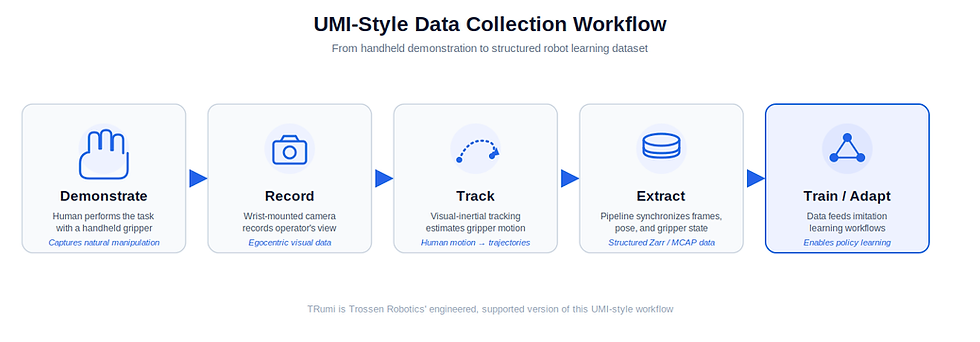
Step | What happens | Why it matters |
Demonstrate | A human performs the task with a handheld gripper | Captures natural manipulation behavior |
Record | A wrist-mounted camera records the operator’s view | Produces egocentric visual observations |
Track | Visual-inertial tracking estimates gripper motion | Converts human motion into end-effector trajectories |
Extract | The pipeline synchronizes frames, pose, and gripper state | Creates structured robot learning data |
Train or adapt | The data can feed imitation learning workflows | Enables downstream policy learning |
In the UMI paper, the handheld device is a trigger-activated 3D-printed parallel jaw gripper with a GoPro camera. UMI captures RGB image observations, 6-degree-of-freedom end-effector pose, and gripper width, then trains visuomotor policies that output end-effector pose and gripper-width actions.
What data does UMI collect?
UMI-style systems are valuable because they preserve action-relevant information, not just video. In UMI, the important signals include:
Signal | Purpose |
Wrist-view RGB video | Shows the task from the manipulation viewpoint |
End-effector pose | Describes how the gripper moves through space |
Gripper width or aperture | Captures grasp timing and opening state |
Timing and synchronization | Keeps observations and actions aligned |
Bimanual relative pose, when using two grippers | Supports coordination between hands or robot arms |
UMI uses a fisheye lens for wide visual context, side mirrors for implicit stereo cues, and GoPro IMU data with visual-inertial SLAM to estimate motion at real metric scale.
Why does end-effector-centric data matter?
End-effector-centric data describes the movement of the gripper through space rather than the joint angles of one specific robot. That makes handheld data attractive for early dataset generation and broader task variation.
The UMI paper uses relative end-effector pose to reduce dependence on robot-specific coordinate frames. It also acknowledges that downstream robot deployment still requires kinematic filtering, because target robot limits are unknown during handheld collection.
UMI data collection is useful because it captures robot-relevant action information from human demonstrations without requiring a full robot setup for every data session. A UMI-style gripper records wrist-view video, end-effector motion, and gripper state, giving robot learning teams a more scalable way to collect diverse manipulation demonstrations.
Where UMI can be hard in practice
UMI is open-source and powerful, but reproducing it is not the same as buying a supported product. The GitHub README shows environment setup, Docker, conda dependencies, a SLAM pipeline, replay-buffer generation, diffusion policy training, and robot deployment configuration. It also says the system was only tested on Ubuntu 22.04 and that OBR_SLAM3 is still the most fragile part of the pipeline.
The UMI paper also notes limitations around target robot kinematic feasibility, visual SLAM texture requirements, and the weight and bulk of the gripper relative to human hand demonstrations.
Where TRumi fits
TRumi takes the UMI-style handheld data collection concept and turns it into a supported product for teams that care about repeatable use. Trossen describes TRumi as a handheld manipulation data collection system that helps teams collect more demonstrations across more objects, environments, and task variations.
TRumi works with Trossen Data Collection Pipelines to:
capture single-gripper or bimanual demonstrations
record wrist-mounted visual observations using a supported GoPro HERO13 Black with Ultra Wide Lens Mod
estimate motion through visual-inertial SLAM
extract synchronized frames, end-effector pose, and gripper aperture
output structured Zarr or MCAP datasets
Best for
TRumi and UMI-style handheld data collection are best for:
Use case | Fit |
Broad task variation | Strong fit |
Multi-site data collection | Strong fit |
Early dataset generation | Strong fit |
Bimanual handheld demonstrations | Strong fit |
Final target robot validation | Use leader-follower or target robot testing |
Not best for
TRumi is not the primary tool for highest-precision robot-specific refinement or final validation on target robot hardware. Trossen states that deployment on a target robot still requires integration and validation, and that TRumi is best for scalable handheld manipulation demonstrations, broader task variation, and dataset generation.
FAQ
What is UMI data collection?
UMI data collection is a handheld demonstration workflow for robot learning. A human uses a UMI-style gripper to record manipulation demonstrations, which are converted into visual observations and end-effector-centric action data.
What is the Universal Manipulation Interface?
Universal Manipulation Interface is the Stanford-originated UMI framework for in-the-wild robot teaching using handheld grippers and policy-learning tools.
What does a UMI gripper record?
A UMI-style gripper records wrist-view visual observations, gripper motion, and gripper state. UMI specifically uses GoPro video, visual-inertial tracking, end-effector pose, and gripper width.
Is TRumi the same as Stanford UMI?
No. Stanford UMI is an open-source research framework. TRumi is Trossen Robotics’ engineered and supported UMI-style handheld manipulation data collection system.
Can TRumi data be used with non-Trossen robots?
TRumi data is centered around end-effector motion rather than a specific robot’s joint configuration. Deployment on a target robot still requires integration, interpolation, inverse kinematics, and validation.
What formats does TRumi output?
TRumi outputs structured Zarr or MCAP datasets through Trossen Data Collection Pipelines.
Does TRumi replace teleoperation?
No. TRumi can scale broad handheld data collection. Leader-follower teleoperation is still useful for final embodiment-specific tuning and validation.
CTA
Talk to Trossen about your data collection workflow. Share what tasks you are collecting, how many devices you need, and what dataset format you are targeting.
Sources
Internal links
External citations
Comments