The Trillion-Dollar Market Hidden in Unautomated Human Labor
Updated: Jul 10
The Short Version
Measure this opportunity as labor exposure first, not robot revenue.
Target the high-mix, low-volume, physically variable work that breaks fixed automation.
Treat SMEs as the core market, since they account for around 90% of businesses worldwide.
Adopt the physical AI model: demonstrate the task, collect data, train policies, evaluate, redeploy.
Buy an integrated stack instead of stitching arms, grippers, cameras, and pipelines from six vendors.
Use the Trossen SDK to record synchronized, multimodal episodes and move them into training pipelines.
Capture worker judgment as demonstration data instead of removing people from the workflow.
Who this is for
Small and medium-sized business owners
Robotics developers and researchers
Automation integrators
Operations and manufacturing leaders
Physical AI and embodied AI teams
Data collection and teleoperation teams
Repetitive, dexterous work powers millions of businesses, but much of it has remained too variable, too fragmented, or too expensive for traditional automation to handle. Physical AI is beginning to change that.
Some of the largest automation opportunities in the world do not look futuristic. They look boring. A person loading parts into a fixture. Packing mixed items into boxes, sorting produce, inspecting, fastening, and repeating the same physical motion hundreds or thousands of times a day. This work is neither glamorous nor always intellectually complex, but it is everywhere. And that's the point.
For decades, industrial automation has transformed the work that was easiest to standardize: high-volume lines, fixed processes, predictable materials, controlled environments. Tasks where custom integration could be justified because the volume was high enough, the process was stable enough, and the payback was clear enough. That model worked. It built the modern factory, raised productivity, and enabled us to produce products at scales and prices that would have been impossible with manual labor alone. But it also left behind an enormous category of work.
I call this unautomated human labor: work businesses still rely on people to do by hand, not because it is uniquely human, but because previous generations of automation could not solve it economically. These are tasks that sit below the automation threshold — repetitive enough to be exhausting, valuable enough to matter, physical enough to require dexterity, variable enough to break fixed automation, and fragmented enough that most businesses cannot justify turning every process into a custom robotics project.
That's the market physical AI is starting to open. Not overnight, not magically, and not in the breathless way robotics is sometimes discussed. But meaningfully.
The world still runs on repetitive work.
The modern economy is not only made up of massive automotive plants, semiconductor fabs, and fully engineered production lines. It is also made of small manufacturers, contract packagers, machine shops, food processors, laboratories, warehouses, farms, repair operations, distributors, and countless businesses where people still do repetitive physical work because it has been too messy, too variable, or too expensive to automate.
That matters because small and medium-sized businesses are not a niche corner of the economy. They are the economy. The World Bank says that small and medium enterprises account for around 90% of businesses worldwide and more than half of global employment.¹ Across OECD countries, SMEs represent around 99% of all firms and generate 50% to 60% of value added on average.²
So when we talk about unautomated labor in small and medium-sized businesses, we are not talking about an edge case. We are talking about a massive part of how the world actually works, and much of that work is still done by hand.
The reason is not that business owners are unaware of automation, or that operators enjoy repetitive motion, or that the industries involved are allergic to technology. It is that the automation model has not fit the problem. Traditional automation works best when the task is highly repeatable, the environment is controlled, the product changes infrequently, and the business can justify the time and cost of integration. That's a powerful model, but it is not universal.
A lot of real work is high-mix, low-volume, physically variable, and full of edge cases. One week, the product changes. One batch is slightly deformed. One object is soft, one item is wet, one tote is overfilled, and one part is reflective. One process requires a small judgment call that an experienced person makes without thinking. Humans are very good at that. Traditional automation is not.
The market is measured in labor, not robot sales.
If we are going to talk about a trillion-dollar market, we should be precise. The claim is not that robotics revenue is automatically a trillion-dollar market; that would be sloppy. The claim is that the labor pool exposed to automation is measured in trillions.
McKinsey Global Institute estimated that almost half of the activities people are paid to do globally, representing almost $15 trillion in wages, had the technical potential to be automated by adapting demonstrated technologies. Just as important, McKinsey found that fewer than 5% of occupations could be fully automated, while about 60% had at least 30% of their activities automatable.³
That distinction is critical. The opportunity is not "jobs robots can replace." It is work that robots can take off people's plates. That's a more honest and more useful way to talk about automation.
Most jobs are bundles of tasks. Some require judgment, communication, intuition, creativity, customer interaction, troubleshooting, and domain expertise. Others require repetitive physical actions that humans perform because automation has not been practical enough. The market I am talking about is the second category: the work still done by hand because it was too variable, too dexterous, too fragmented, or too expensive for traditional automation to reach.
A precise global number is hard to calculate because this work is spread across industries, regions, and business sizes, but the order of magnitude is hard to ignore.
A directional exposure model, not a revenue forecast:
Global automatable wage exposure: ~$15 trillion
SME-linked share: roughly half of global employment
Repetitive physical or dexterous subset: 20% to 40%
Estimated exposed labor base: ~$1.5 trillion to $3 trillion
Again, that's not robotics revenue. It is not a claim that every task is ready to automate tomorrow, or that it will ever be entirely automated. It is the size of the opportunity. And the opportunity is massive.
Traditional automation did not fail. It won the markets it was built for.
It is easy to look at the amount of work still done manually and say traditional automation failed. I don't think that's right. Traditional automation did exactly what it was designed to do. It transformed the environments where repeatability, capital, engineering discipline, and volume all lined up, giving us modern automotive manufacturing, electronics production, packaging lines, and countless forms of process control that quietly keep the economy moving.
The issue is not that traditional automation failed. It was never designed to reach every class of work.
NIST has been direct about this in the context of small manufacturers. Emerging robotic technologies that could help robots operate in high-mix, low-volume environments are difficult to select and integrate effectively without a basis for evaluation, and small manufacturers in particular need help selecting and integrating new technologies for environments that require frequent retasking.⁴
That's the gap. A small manufacturer may have a task that's clearly repetitive. A food processor may have a handling step that clearly wastes labor. A warehouse may have a packing operation that clearly creates fatigue and bottlenecks. But if solving that task requires months of custom integration, expensive fixtures, specialized programming, safety work, support contracts, and a dedicated internal robotics team, the automation threshold is too high. So the work stays manual — not because it should, but because the economics do not work.
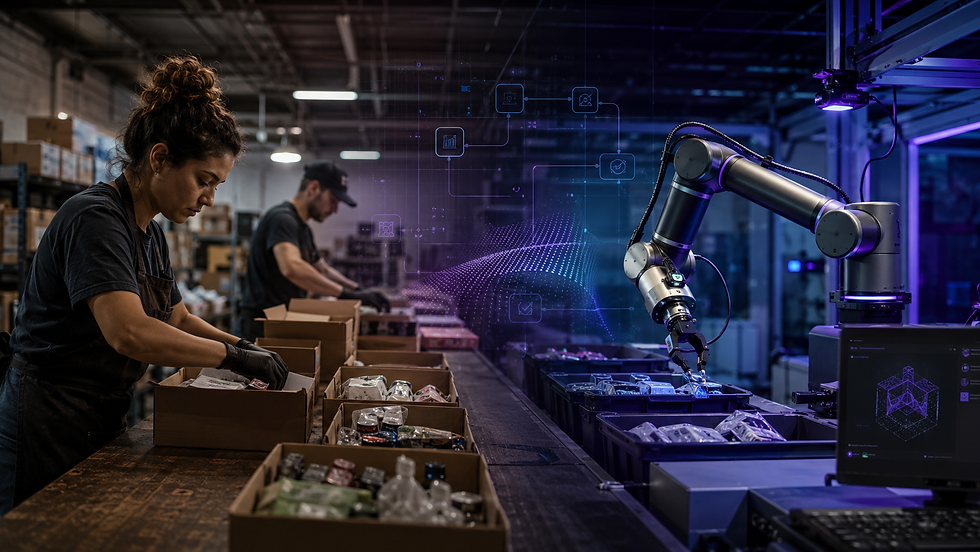
Robotics has grown, but it has not reached the whole physical economy.
Although industrial robotics has reached a level of maturity, it continues to evolve and expand. The International Federation of Robotics reported that 542,000 industrial robots were installed globally in 2024, with annual installations above 500,000 units for the fourth straight year. IFR also reported that Asia accounted for 74% of new deployments in 2024, with China alone accounting for 54% of global deployments.⁵
That distribution tells us something important. Robotics has scaled hardest where the conditions were right: capital, volume, industrial policy, technical expertise, supply chain density, and enough repeatable work to justify the investment. That's not a criticism, but a signal.
The world is not broadly automated. A huge amount of physical work still sits outside the traditional automation model, and that's where the next major opportunity lives. Not just in putting more robots into the places that already know how to buy and integrate them, but in making robotics practical for the places where automation has historically been too rigid, too expensive, and too difficult to deploy.
Physical AI changes the equation.
The old automation model looked something like this: engineer the task, constrain the environment, program the robot, maintain the system. The emerging physical AI model looks different: demonstrate the task, collect data, train or fine-tune policies, evaluate performance, improve with more data, and redeploy.
Old automation model | Emerging physical AI model |
Engineer the task | Demonstrate the task |
Constrain the environment | Collect data |
Program the robot | Train or fine-tune policies |
Maintain the system | Evaluate, improve with more data, redeploy |
That shift matters because it maps more closely to the kind of work that traditional automation struggled to reach.
This does not mean robots can walk into any small business tomorrow and automate everything. Anyone who says otherwise is probably selling a fantasy or has not spent enough time around real hardware. The physical world is still hard. Grasping is hard, edge cases are hard, safety is hard. Customers do not pay for demos. They pay for systems that work on good days and bad days, not just in polished videos.
But the development model is changing in a direction this market needs. Research platforms such as ALOHA and Mobile ALOHA demonstrated that lower-cost hardware, teleoperation, and imitation learning can make dexterous robotic manipulation more accessible. Mobile ALOHA reported that, with 50 demonstrations per task, co-training could increase success rates by up to 90% on complex mobile manipulation tasks.⁶
The broader research field is moving in the same direction. Open X-Embodiment brought together data from 22 different robots and 527 skills, and the research team reported that RT-1-X achieved a 50% higher success rate than original, state-of-the-art methods contributed by collaborating institutions.⁷
The details will keep changing. The models will improve, the architectures will evolve, and some approaches will overpromise and disappear. That's normal. But the direction is clear. Robotics is moving from one-off programming toward systems that can learn from demonstrations, improve through data, and become easier to adapt over time. That's a very different foundation for the unautomated labor market.
Why is this happening now?
The pieces have moved quickly, and together they shifted the whole development surface. A reasonable question: why now, and not five years ago?
Bimanual teleoperation hardware that used to cost six figures is now available at a fraction of that.
Cross-embodiment datasets gave the field something closer to a shared pretraining base.
Vision-language-action models began to show meaningful generalization across tasks.
Diffusion policies, behavior-cloning improvements, and better evaluation methods advanced in parallel.
Open data formats and standardized training pipelines reduced the distance between a recorded demonstration and a working policy.
None of these individually solved the physical world. But together, they shifted the development surface. The cost of trying things is lower, the cost of being wrong is lower, and the feedback loop is faster. That's the shift that makes the question of unautomated labor newly answerable, even if the answer is still hard to build.
The barrier is not just intelligence. It is accessibility.
This is where I think many robotics conversations go wrong. People obsess over the model. The model matters, obviously — better foundation models, vision-language-action models, imitation learning, diffusion policies, and agentic systems are all part of the story. But intelligence is only one piece of the adoption problem.
A business does not adopt a model. It adopts a system. That system needs hardware, end effectors, cameras, compute, data collection, teleoperation, safety practices, documentation, support, training, maintenance, integration paths, APIs, real-time control, evaluation workflows, and people who can help when something breaks.
The agentic layer matters because it can help systems plan, coordinate, recover, and work across more complex instructions. Still, in the physical world, agency only matters if it can be grounded in reliable hardware, usable data, safe execution, and a workflow that real teams can actually operate. If those pieces are too expensive, too fragmented, or too hard to use, the market stays small.
That's especially true for small and medium-sized businesses. They do not have unlimited engineering bandwidth, they do not want a science project, and they do not want six vendors pointing at each other when something does not work. A team that buys an arm from one company, a gripper from another, cameras from a third, and a data pipeline from a fourth often spends more time integrating than improving.
They need a practical path from "this task looks automatable" to "we can test, train, improve, and deploy something useful." That's the part of the market I care about most, because the future of robotics is not just better robots. It is a lower barrier to useful automation.
Where does Trossen fit?
At Trossen Robotics, we have spent years focused on making robotics easier to build on — not because "easy" is a nice marketing word, but because difficulty is the barrier that keeps useful automation out of reach. If every repetitive task requires a custom engineering project, the market stays small. If teams can start with capable hardware, collect data, test policies, improve the system, and get real support when things break, the market gets bigger.
That has been a consistent thread in our work. We have supported the research community through platforms widely used for machine learning, teleoperation, imitation learning, and embodied AI. More recently, we have been focused on the physical AI development stack around the robot: teleoperation, data collection, real-time control, software workflows, documentation, and systems that help teams get from demonstration to usable training data faster.
The Trossen SDK is one example of that philosophy: an open-source C++ framework for robotics and physical AI data collection, designed to record synchronized, multimodal episodes from robot arms, cameras, and mobile bases, then move that data into formats modern training pipelines can use.⁸
That's the kind of infrastructure this next market needs. Not just arms, not just models, not just demos, but a practical stack that makes robotics easier to develop, support, iterate, and integrate into real work. Trossen's role is not to claim that every boring task can be automated tomorrow. That would be unserious. Our role is to lower the automation threshold and give researchers, developers, integrators, and businesses the tools to attack repetitive physical work without starting from zero every time.
The labor question deserves honesty.
Any time you talk about automating human labor, you have to be honest about displacement. It is not enough to say "robots do the dull, dirty, and dangerous work" and move on. That phrase is useful, but it can also become a way to avoid the harder question. Automation changes work.
It always has. Some tasks disappear, some roles shrink, and some people are forced to adapt faster than is comfortable or fair. There are communities and industries where technological change does not feel like progress in the moment; more like instability. Anyone working in robotics should take that seriously.
The story doesn't end with the loss of jobs. It never has. Economist David Autor has noted that while automation does replace certain types of labor, it also complements it. Automation increases productivity, which can lead to higher demand for workers, and it interacts with broader adjustments in the labor market.⁹
That's the more complete story. The World Economic Forum's Future of Jobs Report 2025 projects that structural labor-market shifts could create 170 million new roles while displacing 92 million by 2030, for a net increase of 78 million jobs. That's still a massive disruption, but it is not a one-way story of disappearance.¹⁰
That matters for physical AI. If robotics is going to scale responsibly, the goal cannot simply be to remove people from workflows. The goal should be to move people toward the work humans are better at: judgment, troubleshooting, communication, creativity, intuition, process improvement, customer interaction, training, maintenance, and problem-solving.
The worker who knows exactly how a product behaves when it is slightly wet, warped, sticky, underfilled, overfilled, or out of place has knowledge the system needs. The future should not waste that knowledge — it should capture it, elevate it, and turn it into better automation. Physical AI should not be built around the idea that humans are disposable, but around the idea that human judgment is too valuable to waste on the same dull motion all day.
Transformational technologies create markets around themselves.
This is where the conversation gets more interesting. Every major technology shift creates displacement, but it also creates entirely new support markets. Cars didn't just replace horses, but they also created mechanics, dealerships, road construction, logistics networks, parts suppliers, insurance models, fuel infrastructure, trucking, and entirely new patterns of commerce. Computers didn't only automate clerical work, they created IT departments, software companies, cybersecurity, cloud infrastructure, e-commerce, digital marketing, data science, SaaS, and a global technology services economy.
Physical AI will do the same. It will need robot operators, robot trainers, field technicians, integration specialists, data collection teams, safety auditors, workflow designers, maintenance providers, application engineers, customer support teams, and domain experts who can translate real-world work into teachable machine workflows. That deserves its own article, and it will probably be the next one. The pattern is worth understanding clearly: transformational technology not only automates existing work, but it also creates the markets required to implement, support, maintain, and improve the technology itself.
The difference this time is that AI may also help people transition faster. The same AI wave that makes robots easier to train can also make people easier to retrain, by creating documentation, simulations, troubleshooting guides, role-specific training, internal copilots, and personalized learning paths for workers moving from repetitive execution into higher-leverage technical and operational roles.
That does not happen automatically. It has to be built intentionally. But it is possible, and if physical AI is going to be worth building, that has to be part of the vision.
What this changes
The market should be measured first as labor exposure, not robot revenue.
The bottleneck is not only robot intelligence. It is the cost of retasking, integration, support, and data collection.
Traditional automation won fixed, repeatable environments. Physical AI's opportunity is the messy middle.
SMEs are not a side market. They are where much of the unautomated physical economy lives.
Human expertise does not disappear from this workflow. It becomes demonstration data, supervision, exception handling, and process knowledge.
The real opportunity
The world does not need robotics to be more theatrical; it needs to be more useful. The biggest opportunity is not necessarily humanoid robots walking around just to look human — it is automation that finally becomes practical enough to handle the repetitive, dexterous work businesses have been doing by hand for decades.
The trillion-dollar market hidden in unautomated human labor isn't hidden because no one sees the work. Everyone sees the work. Workers feel it, managers schedule around it, business owners pay for it, customers depend on it, and entire supply chains absorb its inefficiencies. It is hidden because, until recently, the automation model did not fit.
Physical AI is starting to change that. Not by pretending the physical world is easy, not by pretending every job disappears, not by pretending robots are magic, but by giving us a new path: accessible hardware, better teleoperation, better data collection, better learning systems, better support, and platforms that reduce the barrier between a repetitive task and a working robotic workflow.
That's the future worth building. Not robots replacing humans as an end goal, but machines finally becoming practical enough to take on the work we should have automated a long time ago, so people can spend more of their time doing the work humans are actually best at.
Endnotes
World Bank, "SMEs Finance." Notes that SMEs account for around 90% of businesses worldwide and more than half of global employment. https://www.worldbank.org/ext/en/topic/competitiveness/small-and-medium-enterprises-smes-finance
OECD, "SMEs and Entrepreneurship." States that SMEs represent around 99% of firms across OECD countries and generate 50% to 60% of value added on average. https://www.oecd.org/en/topics/policy-issues/smes-and-entrepreneurship.html
McKinsey Global Institute, "A Future That Works: Automation, Employment, and Productivity." Estimates that almost half of paid work activities globally, representing almost $15 trillion ($15.8 trillion in the full report) in wages, had technical automation potential using demonstrated technology. https://www.mckinsey.com/~/media/mckinsey/featured%20insights/digital%20disruption/harnessing%20automation%20for%20a%20future%20that%20works/mgi-a-future-that-works-in-brief.pdf
NIST, "Performance of Emerging Technologies for Robotics." Discusses barriers to robotics adoption among small and medium-sized manufacturers, including dynamic environments, high-mix/low-volume work, frequent retasking, and integration difficulty. https://www.nist.gov/programs-projects/performance-emerging-technologies-robotics
International Federation of Robotics, "Global Robot Demand in Factories Doubles Over 10 Years." Reports 542,000 industrial robot installations in 2024, with Asia accounting for 74% of new deployments and China accounting for 54% of global deployments. https://ifr.org/ifr-press-releases/global-robot-demand-in-factories-doubles-over-10-years
Mobile ALOHA project materials. Reports that with 50 demonstrations per task, co-training can increase success rates by up to 90% on complex mobile manipulation tasks. https://mobile-aloha.github.io/
Open X-Embodiment / Robotics Transformer-X project materials. Reports data from 22 robots and 527 skills, with RT-1-X showing a 50% higher success rate than original methods contributed by collaborating institutions. https://robotics-transformer-x.github.io/
Trossen Robotics, "Open-Source Robotics Data Collection for Physical AI." Describes the Trossen SDK as an open-source C++ framework for recording synchronized, multimodal robotics data from arms, cameras, and mobile bases. https://www.trossenrobotics.com/post/trossen-sdk-open-source-robotics-data-collection
David Autor, "Why Are There Still So Many Jobs? The History and Future of Workplace Automation." Discusses how automation substitutes for some labor while also complementing labor, raising output, and creating broader labor-market adjustment. https://www.aeaweb.org/articles?id=10.1257/jep.29.3.3
World Economic Forum, "Future of Jobs Report 2025." Projects 170 million new roles and 92 million displaced roles by 2030, for a net increase of 78 million jobs, while emphasizing urgent workforce upskilling. https://www.weforum.org/publications/the-future-of-jobs-report-2025/
References
Frequently Asked Questions
What is the trillion-dollar market hidden in unautomated human labor?
It is the repetitive, dexterous physical work businesses still do by hand because it was too variable, too fragmented, or too expensive for traditional automation to reach. Physical AI is beginning to make that work economically automatable.

Is the trillion-dollar figure a robotics revenue forecast?
No. The claim is that the labor pool exposed to automation is measured in trillions, not that robotics revenue is. A directional exposure model puts the repetitive physical or dexterous subset at roughly $1.5 trillion to $3 trillion.
Why does unautomated labor still exist?
Not because owners are unaware of automation, but because the traditional model did not fit high-mix, low-volume, physically variable work. Integration cost, custom fixtures, and support requirements pushed the automation threshold too high.
How does physical AI change the automation equation?
The old model engineered the task, constrained the environment, and programmed the robot. Physical AI instead demonstrates the task, collects data, trains policies, evaluates, and improves with more data—mapping to work fixed automation struggled to reach.
Why is this happening now and not five years ago?
Bimanual teleoperation hardware that once cost six figures is now a fraction of that, cross-embodiment datasets created a shared pretraining base, and vision-language-action models, diffusion policies, and standardized pipelines advanced in parallel.
What is the Trossen SDK?
The Trossen SDK is an open-source C++ framework for robotics and physical AI data collection, designed to record synchronized, multimodal episodes from robot arms, cameras, and mobile bases, then move that data into formats modern training pipelines can use.
Does automating this labor just eliminate jobs?
No. The WEF Future of Jobs Report 2025 projects 170 million new roles created and 92 million displaced by 2030, a net increase of 78 million jobs. The goal is to move people toward judgment, troubleshooting, and problem-solving.
Comments