Machine Learning Robotics: From Data to Deployment
Updated: 4 days ago
Machine Learning Robotics: From Data to Deployment
Robots become more capable when they can learn from varied examples, respond to changing conditions, and use feedback to improve each action. In manipulation, that shift is practical: a grasp, sort, or bimanual task rarely unfolds exactly as it did during a demonstration.
Answer: Machine learning robotics combines sensor data, demonstrations, learned policies, and control so robots can adapt beyond fixed instructions. A dependable program collects representative examples, trains and evaluates models, and deploys them on extensible hardware with the monitoring and iteration needed for repeatable results.
Trossen Robotics supports this full workflow with modular, research-grade platforms for teleoperation, data collection, model development, evaluation, and deployment. The goal is not a one-time demonstration. It is a practical system that helps a research lab, enterprise R&D team, startup, or data collection organization move from a defined task to evidence-backed improvement. Teams can explore the ALOHA Solo platform when a single-arm data-collection setup fits the experiment, or evaluate the broader ALOHA Stationary platform for coordinated bimanual work.
What Is Machine Learning Robotics?
Answer: Machine learning robotics is the use of data-driven models within a robotic system to interpret observations, select actions, or improve control. It works alongside calibrated hardware, safety limits, motion planning, and feedback loops rather than replacing the engineering layers that make physical operation repeatable. In practice, models add adaptability while the surrounding system makes behavior measurable and repeatable.
Traditional robotics often begins with explicit rules. An engineer may define a sequence that moves an arm to known coordinates, closes a gripper, and places an object in a fixed location. That method can be effective when the workspace, object geometry, lighting, and timing stay consistent. The maintenance burden grows when those conditions vary.
Machine learning changes where the behavior comes from. Instead of describing every response by hand, a team provides examples, labels, demonstrations, or task feedback. A model can then estimate what an object is, where it is located, which grasp may work, or what action should come next. The model is still part of a larger engineered system. It needs a defined task, suitable sensors, control interfaces, evaluation criteria, and an operating boundary.
Feedback control and machine learning are related but distinct. A feedback controller compares a measured state with a desired state and adjusts the command to reduce error. Encoder, force, and vision measurements can help maintain a trajectory or grip. A learned model may provide the perception estimate, choose an action. Or adapt a policy when the relationship between sensor input and useful behavior is difficult to express with fixed rules.
Consider a sorting task. A fixed program can route objects when their positions and appearances are tightly constrained. A learned perception model can help identify a wider range of shapes or orientations. A learned policy can help select an approach or grasp. The execution layer still needs calibrated motion, collision limits, and recovery logic. Machine learning contributes adaptability, but reliability comes from coordinating models with physical and software safeguards.
This distinction is important for teams buying or building a research platform. The useful question is not whether a robot has artificial intelligence as a label. The useful question is whether the system supports the complete loop of collecting data, testing behavior, measuring failure modes, and improving the next version. The National Science Foundation describes robotics research in terms of robots interacting with and adapting to their environments. While academic research identifies learning methods as important tools for increasingly capable manipulation (National Science Foundation robotics research; academic research on robotic manipulation).
How Do Robots Learn From Data?
Answer: Robots learn from data by converting observations, demonstrations, and task outcomes into models that guide perception or action. Supervised learning, imitation learning, reinforcement learning, simulation, and transfer methods serve different purposes. Each depends on representative examples, consistent recording, and evaluation on conditions beyond the training set.
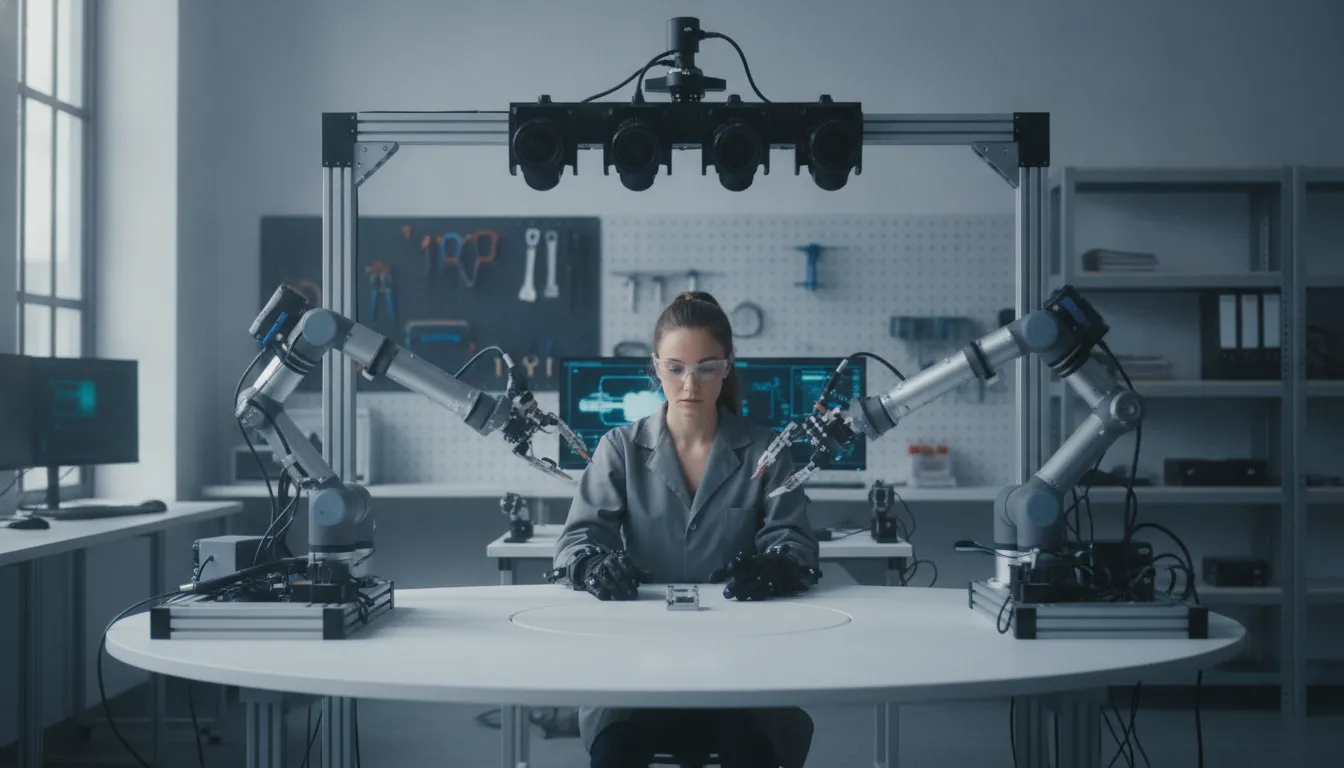
Teleoperated demonstrations give a robot learning system examples of task behavior and outcomes. For teams studying bimanual manipulation, the ALOHA project provides useful context for coordinated hardware and repeatable research workflows.
Supervised learning for perception and prediction
Supervised learning uses paired examples. A sensor observation may be matched with an object class, pose estimate, desired position, or task label. The model learns to predict an output from a new input. This approach can support perception and action selection when the examples represent the conditions the robot will encounter.
Dataset design matters as much as model selection. A collection that contains only centered objects under one lighting condition may produce impressive results in a matching test while failing in a broader workspace. Teams should record meaningful variation in object position, surface, lighting, camera viewpoint, and task timing. Clear metadata helps separate a model limitation from a missing slice of the dataset.
Imitation learning from teleoperation
Imitation learning uses demonstrations as the teaching signal. An operator can guide a robot through a grasp, sorting action, or bimanual sequence. The recorded trajectory shows a policy what successful behavior looks like and can provide a starting point for learning from more varied conditions.
Teleoperation is especially useful when the desired behavior depends on contact, timing, or human judgment. It also makes data collection an operational workflow rather than an occasional manual exercise. Consistent camera placement, synchronized state capture, and clear episode boundaries make demonstrations easier to inspect and reuse.
Reinforcement learning, simulation, and transfer
Reinforcement learning improves a policy through feedback from a defined objective. Actions that move toward the objective receive a stronger signal, while ineffective actions receive less favorable feedback. It can be useful for refining behavior, but the objective, exploration boundary, and evaluation method must be designed carefully.
Simulation can expand early experimentation and reduce the cost of testing some policy changes. Transfer methods can help carry knowledge from simulated environments to physical hardware. Simulation does not eliminate the need for real-world data because friction, lighting, calibration, contact, timing, and sensor behavior may differ.
Why evaluation data is part of learning
A dataset should include more than successful demonstrations. Verified failures, intervention points, recovery attempts, and held-out episodes show where a policy depends on narrow assumptions. A team that tracks those details can decide whether the next improvement requires new data, a changed model, a calibration adjustment, or a revised task definition.
The National Institute of Standards and Technology highlights datasets and benchmarking as important supports for machine learning in manufacturing robotics (NIST research on machine learning in manufacturing robotics). In practice, a repeatable evaluation record turns model development into a measurable engineering process.
How Does Machine Learning Improve Robotic Manipulation?
Answer: Machine learning improves robotic manipulation by helping a robot interpret changing scenes, estimate grasp opportunities, select actions, and adapt to variation. The strongest systems pair learned perception or policies with calibrated motion, feedback, collision limits, recovery behavior, and evaluation that measures more than task completion.
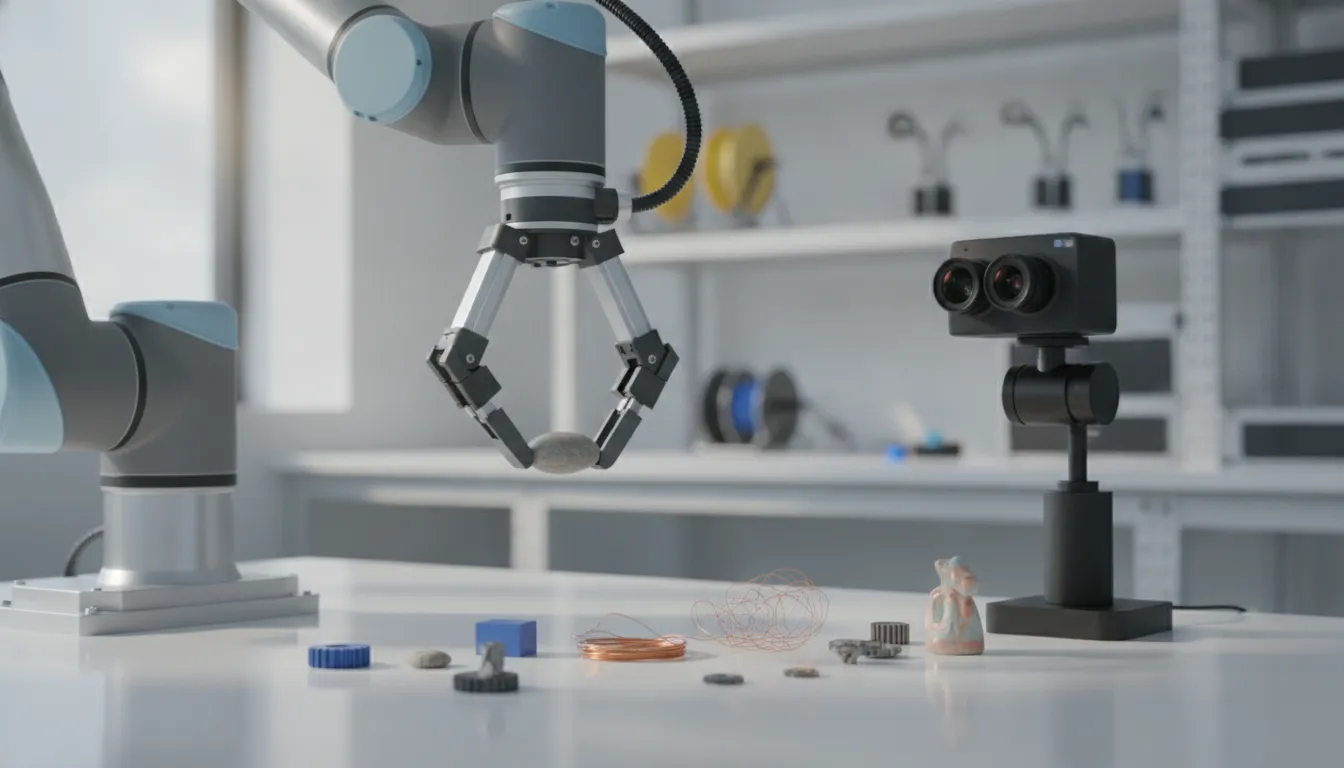
Manipulation experiments connect learned behavior with physical sensing, control, and recovery.
Manipulation is difficult because objects, contact conditions, and viewpoints change. A model can help estimate object pose from vision, classify a target, predict a useful grasp, or select the next action from sensor observations. These capabilities are valuable when fixed coordinates do not capture the full task.
Single-arm and bimanual behavior
Single-arm tasks may involve picking, placing, sorting, insertion, or tool use. The data should represent the object variation and workspace conditions that matter to the experiment. Evaluation should record completion, intervention, recovery, and the conditions that produced each result.
Bimanual manipulation adds coordination. Both arms must respond to a shared object state and maintain useful timing across actions. Demonstrations should capture both arms, camera observations, contact events where available, and task outcomes. A platform that supports repeatable bimanual data collection gives researchers a stronger basis for studying coordinated policies.
Learned behavior does not remove the need for engineered constraints. A deployment system still needs motion limits, collision handling, control rates, state monitoring, and a safe response when the model is uncertain. The role of machine learning is to improve decisions within a well-defined operating envelope.
From Demonstration to Deployment: The Machine Learning Robotics Workflow
Answer: A practical machine learning robotics workflow moves from a defined task to representative demonstrations, validated datasets, trained models, held-out evaluation, and monitored deployment. Each stage should produce evidence that guides the next experiment instead of treating a single successful run as proof of generalization.
- Define the task and success criteria.
Specify the object, workspace, desired outcome, meaningful variations, and measurable completion conditions.
- Configure the platform.
Select the manipulator, end effector, sensing, fixtures, and control interfaces needed for the task.
Collect representative episodes.
Capture demonstrations, actions, camera observations, timestamps, episode boundaries, and task results. Teleoperation can provide repeatable examples for grasping, sorting, and bimanual manipulation. Trossen's
supports a structured path from teleoperation and capture toward training-ready data.
- Validate and prepare the dataset.
Check for incomplete episodes, corrupted streams, timing mismatches, and unclear labels. Standardize formats and document the conditions represented. Keep the original recordings and the processed training set traceable to one another.
- Train a model or policy.
Choose the method that fits the task and available evidence. Record model versions, configuration, training data, and hardware assumptions.
- Evaluate on held-out conditions.
Test variation that was not used for training. Track success, intervention, recovery, latency, and failure categories.
- Deploy with monitoring.
Define operating limits, observe model behavior, and preserve enough data to investigate unexpected outcomes.
- Use evidence to plan the next cycle.
Convert failures and gaps into new demonstrations, data checks, model changes, or hardware adjustments.
This sequence keeps the research loop visible. Data collection informs training. Training informs evaluation. Evaluation identifies the next useful experiment. A modular hardware and software foundation lets teams repeat that loop as tasks, models, and deployment requirements evolve.
What Hardware and Software Does Machine Learning Robotics Require?
Answer: A machine learning robotics stack needs manipulators, sensing, control hardware, compute, data tools, robotics software, and evaluation environments. The important design property is integration: each layer should support a repeatable path from teleoperation and data capture to training, testing, and deployment.
Layer | Typical components | Role in the workflow |
Manipulation | Robot arms, grippers, and fixtures | Execute repeatable actions such as grasping, sorting, and placement. |
Perception | RGB-D cameras and robot sensors | Capture visual and spatial observations for a learned policy. |
Control | Controllers, drivers, and state feedback | Connect model actions to bounded, measurable robot motion. |
Compute | Control computers, training hardware, and storage | Run robot software, process data, train models, and retain experiment history. |
Data tools | Teleoperation tools, SDKs, and compatible formats | Record demonstrations, convert datasets, and compare outcomes. |
Evaluation | Held-out tasks, simulation, and monitoring | Test generalization and guide the next improvement cycle. |
Integration quality matters as much as the individual components. A research team may use ROS 2 for software connections, RGB-D sensing for three-dimensional observations, and a data format that moves demonstrations into a learning pipeline. Simulation can support early task development, while physical evaluation remains necessary for contact, timing, calibration, and hardware behavior.
Trossen provides Solo AI, Stationary AI, and Mobile AI systems for data collection and lab workflows, along with WidowX AI manipulators and an open data collection SDK. The platform ecosystem is designed to support teleoperation, model development, and repeatable physical AI work. Teams can review the AI robotics platform overview when aligning hardware and software requirements.
How Can Teams Build a Repeatable Machine Learning Robotics Program?
Answer: Teams build a repeatable machine learning robotics program by narrowing the first task, documenting every data and model version, evaluating on held-out conditions, and designing hardware for iteration. Clear ownership, observable metrics, and a defined path from failure evidence to new data turn experiments into an extensible engineering process.
Start with one task that is specific enough to measure. Define what the robot must do, what counts as success, which variations matter, and which actions require an operator. A narrow first milestone creates a useful baseline and prevents a team from collecting large volumes of data without a clear evaluation target.
Next, make the data pipeline inspectable. Store sensor streams, robot state, actions, task outcomes, and metadata together. Track which dataset version trained each model and which hardware configuration produced each evaluation. When a result changes, the team should be able to identify whether the cause was data, model settings, calibration, software, or the physical environment.
Use evaluation to guide decisions rather than to produce a single headline score. Completion rate is useful, but it should be paired with intervention rate, recovery behavior, latency, and failure categories. A policy that succeeds only under one camera angle may need more representative data. A policy that sees the right object but produces unstable motion may need a control or task-design change.
Design the physical platform for the next experiment, not only the first one. Consistent arm and camera placement makes comparisons easier. Accessible sensors and modular interfaces make it practical to test a new observation or policy. Documentation and technical support reduce the time spent reconstructing setup details when a project moves from one researcher or site to another.
This approach is useful across Trossen's customer segments. University labs can connect demonstrations to reproducible research. Enterprise R&D teams can evaluate a proof of concept against operational conditions. Physical AI startups can move quickly from a working experiment to a stronger data pipeline. Data collection organizations can standardize episodes and quality checks across a growing fleet.
The long-term objective is a system that gets better with evidence. Data collection informs training. Training informs evaluation. Evaluation identifies the next useful experiment. A modular hardware and software foundation lets teams repeat that loop as tasks, models, and deployment requirements evolve.
Frequently Asked Questions About Machine Learning Robotics
Answer: Machine learning robotics is most effective when teams connect learned models to dependable sensing, control, data management, and evaluation. The right platform supports that connection across the full lifecycle, from the first teleoperated demonstration to monitored deployment and the next round of improvement.
What is the difference between machine learning and traditional robot programming?
Traditional programming specifies behavior through explicit rules, trajectories, and control logic. Machine learning uses examples or feedback to estimate perception, actions, or policies. Most practical systems combine both approaches. Learned components handle patterns and variation, while programmed control and safety layers provide structure, limits, and predictable execution.
What data do robots need for machine learning?
Robots may need synchronized camera observations, joint states, actions, task outcomes, and metadata. The useful amount depends on the task and variation. Representative coverage is more important than a large unstructured collection. Include the object poses, environments, and failure conditions that the deployed system is expected to handle.
Can machine learning robotics work with bimanual manipulation?
Yes. Bimanual systems can learn coordinated behavior from demonstrations and task feedback. The dataset should capture both arms, object state, camera observations, timing, and outcomes. Evaluation should measure coordination, contact behavior, recovery, and operator interventions, not only whether the final object reached a destination.
Is simulation enough to train a robot?
Simulation can support task development, policy testing, and additional coverage, but it is not a complete substitute for physical data. Real hardware introduces calibration, friction, lighting, contact, timing, and sensor effects that may not be modeled accurately. Physical evaluation is needed before a policy is trusted for a real workflow.
How should a team choose a machine learning robotics platform?
Start with the workflow rather than a single specification. Confirm that the platform supports the required manipulation task, sensing, teleoperation, data formats, control interfaces, compute, evaluation, and documentation. A modular system with an open software path can reduce rework as the team moves from research experiments toward repeatable deployment.
Build the Next Robot Learning Experiment
The next step is to define one measurable manipulation task, identify the data it requires, and choose an infrastructure path that supports collection, evaluation, and iteration. Trossen Robotics helps teams build that path with research-grade robotic platforms, open tooling, developer documentation, and long-term technical support. Teams can contact Trossen Robotics to connect their robot learning goals with a practical platform.
Comments