Foundation Models for Robot Manipulation Guide
Updated: Sep 15
Robot manipulation research is moving from isolated demonstrations toward repeatable systems that can collect data, train policies, and run them on physical hardware. Models such as pi0, BiACT, and OCTO make that workflow more capable, but their value depends on the platform around them: dependable actuators. Consistent sensing, teleoperation, and data pipelines that preserve the relationship between observations and actions.
Answer: foundation models for robot manipulation are broadly trained policies that connect visual and language observations to robot actions, helping researchers adapt one system to multiple tasks and embodiments. On Trossen Robotics platforms, teams can connect those models to practical workflows for data collection, policy inference, evaluation, and iteration.
The engineering decisions become clearer when the model is viewed as one part of a complete physical AI stack. Understanding how these models generalize, what data they require. And how their action outputs map to real robot control provides the foundation for comparing pi0, BiACT, and OCTO in deployment.
What Are Foundation Models for Robot Manipulation?
Answer: Foundation models for robot manipulation are large pre-trained models that learn from broad, diverse data, then transfer what they learned across tasks, objects, and robot embodiments. In practice, many are vision-language-action (VLA) systems: they combine visual observations and language instructions with action outputs that control a robot. The goal is not a single scripted behavior, but a reusable policy that can adapt as the task or hardware changes.
The ManiFoundation paper describes broad-data training as a foundation for versatile robotic tools. That distinction matters for physical AI research. A model trained across varied demonstrations can provide a stronger starting point than a policy trained from scratch for every new manipulation task. While still leaving room for task-specific fine-tuning and evaluation. Researchers can then connect the model to reliable robot arm manipulation systems and measure how well it transfers to real hardware.
Action-chunking transformers
Action-chunking models predict a sequence of future actions instead of emitting only one control step at a time. This can make policy inference more coherent for demonstrations that involve several coordinated movements. The Action Chunk Transformer (ACT) is a representative example. The Argo-Robot implementation reports 80-90% success rates on fine manipulation tasks with only 10 minutes of demonstrations. That result illustrates why action chunking is useful for fast iteration, although performance still depends on the task, data quality, calibration, and embodiment.
Diffusion-based policies
Diffusion-based policies generate actions through an iterative denoising process. For manipulation. This gives the policy a way to represent multiple plausible action trajectories before selecting a usable sequence. pi0 belongs to this category and is also described as a VLA model. Linking visual input and language-conditioned intent to robot actions. Its appeal is the combination of broad pre-training with a policy representation suited to continuous, contact-rich control.
Open-source generalist models
Open-source generalist models such as OCTO emphasize shared research infrastructure and broader robot-data coverage. They are designed to support transfer across embodiments rather than binding a policy to one robot configuration. For engineering teams, that openness makes it easier to inspect pipelines, adapt data formats, fine-tune a model, and compare results across platforms. These three categories overlap in practice: a project may use a generalist VLA backbone, diffusion-based action generation, and action chunking within the deployment workflow.
Choosing among them starts with the experiment: the required control style, available demonstrations, target embodiment, and level of community support. The model is only one part of the system. Teleoperation, data capture, calibration, inference, and repeatable hardware all shape whether a promising policy becomes a dependable manipulation workflow.
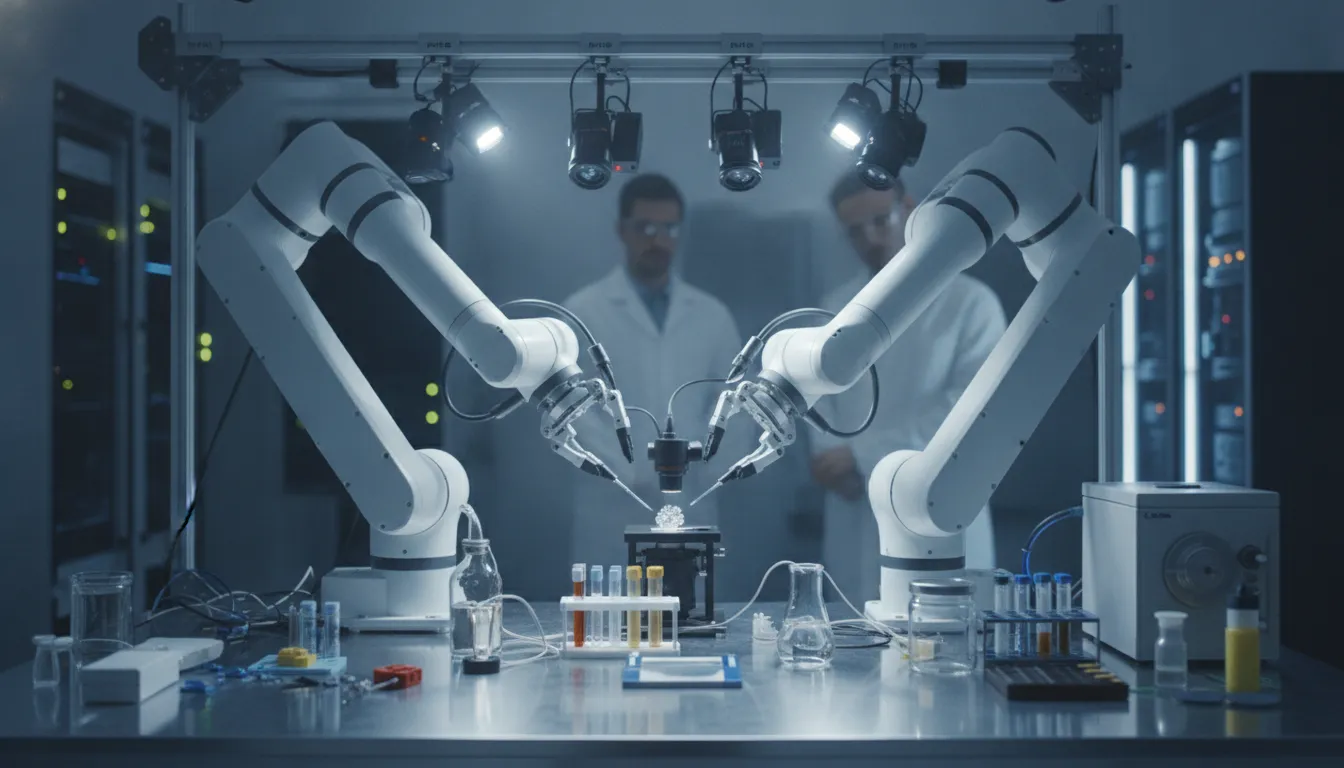
Working with pi0: Physical Intelligence's General-Purpose Foundation Model
Answer: pi0 is a diffusion-based vision-language-action (VLA) model designed to connect visual observations and language instructions with continuous robot actions. Its value for physical AI research comes from training across diverse manipulation data, then adapting that general capability to a specific robot, task, and operating environment.
Physical Intelligence developed pi0 as part of its effort to build general-purpose robotic intelligence. Sergey Levine co-founded the company in 2024, as described in the Foxglove Actuate talk on robotic foundation models. The company has also raised more than $1 billion, reflecting the scale of investment behind general-purpose robot learning. For researchers, the practical question is not only how large the model is, but how efficiently it can be connected to reliable hardware and a repeatable data workflow.
Why diffusion matters for robot actions
Many vision-language-action systems predict what a robot should do from camera observations, language, and the current state of the robot. pi0 uses a diffusion-based action-generation approach. Allowing the policy to model a distribution of plausible action sequences instead of selecting every motor command through a single direct prediction. That is useful for manipulation, where several trajectories may complete the same instruction and where small changes in object pose. Grip, or camera viewpoint can alter the best motion.
The model still needs an embodiment-aware interface. Joint limits, actuator behavior, camera placement, calibration, control frequency. And safety constraints all shape whether a policy that looks promising in a notebook can perform consistently on a physical platform. This is why the hardware and data pipeline should be treated as part of the model development environment, not as an afterthought.
From teleoperation to policy deployment
A practical pi0 workflow begins with teleoperation. An operator demonstrates representative tasks on a Trossen platform while the system records observations, actions, and robot state. Researchers can then organize those demonstrations for training, evaluate the resulting policy on held-out variations, and deploy inference back to the same class of hardware. This loop makes it possible to move from a first demonstration to repeatable experiments without rebuilding the stack for every iteration.
Trossen maintains a dedicated OpenPi fork with pi0 and pi0.5 policy support on its hardware. The integration connects the model to the platform layer where researchers collect demonstrations, test policy inference, and refine task-specific behavior. See Trossen AI Arms integrated into OpenPi for VLA models for details on that connection.
In practice, teams can use teleoperation to expand coverage for edge cases, retrain or adapt the policy, and compare performance across real objects and environments. That combination of an open model interface, accessible manipulation hardware, and structured data collection gives pi0 research a direct path toward measurable physical results.
BiACT: Bidirectional Action Chunking for Bimanual Manipulation
Answer: BiACT extends Action Chunking Transformer (ACT) for coordinated control of two robot arms, making it a practical policy architecture for bimanual manipulation research on ALOHA-aligned hardware.
Standard ACT predicts a sequence, or chunk, of future actions rather than one command at a time. That reduces the burden on high-frequency policy inference and helps a learned controller execute smooth manipulation behavior. BiACT applies the same action-chunking principle to both arms while modeling their coordination in both directions. Each arm can respond to the other arm's state and planned motion. Which is important when one arm stabilizes an object while the other folds, inserts, opens, or assembles it.
Why bidirectional action matters
Bimanual tasks are not simply two independent single-arm tasks. Contact timing, object pose, grasp forces, and workspace constraints connect the arms throughout the motion. A controller that predicts coordinated action chunks can represent those dependencies more directly than a pipeline that plans each arm in isolation. The result is a policy structure suited to handoffs, synchronized grasping, tool use, and manipulation of deformable or awkward objects.
The original ACT implementation reports 80% to 90% success on fine manipulation tasks with only 10 minutes of demonstrations, according to the Argo-Robot ACT implementation. That result is a useful reference point for researchers planning demonstrations, though performance will vary with task complexity, camera placement, embodiment, and data quality.
Deploying BiACT on a Trossen dual-arm platform
A practical workflow starts with teleoperation demonstrations captured from both arms, along with synchronized observations, joint states, and task-relevant camera streams. Convert the demonstrations into the training format expected by the BiACT implementation, then train and evaluate the policy in simulation or on a controlled physical task. During deployment, the policy emits coordinated action chunks, while the robot control layer handles timing, limits, and safe execution.
Trossen's alignment with the ALOHA ecosystem gives researchers a familiar foundation for this workflow. The Stationary AI platform starts at $23,995.95, while Mobile AI configurations range from $33,695.95 to $37,845.95. These platforms provide a repeatable path from data collection to evaluation on real hardware. Explore Trossen's bimanual manipulation platforms to compare the ecosystem and identify a configuration that matches your workspace, mobility, and sensing requirements.
OCTO: Building with Open-Source Robot Foundation Models
Answer: OCTO is an open-source robot foundation model developed through the Open X-Embodiment collaboration. It learns from data collected across diverse robot embodiments. Giving researchers a starting policy that can be adapted to new manipulation tasks instead of trained from zero for every individual setup.
That breadth matters because robot learning data is often tied closely to a particular arm, camera arrangement, action space, and recording pipeline. OCTO's generalist approach creates a path from shared demonstrations to task-specific policies, while keeping the model and training workflow available for inspection, experimentation, and reproducible research.
Connecting OCTO to Trossen hardware
The practical integration point is the data and policy pipeline. Trossen's SDK provides direct conversion to the LeRobot V2 format and native support for LeRobot workflows. Allowing data collected on compatible Trossen platforms to move into a model-training environment without an ad hoc translation layer. The SDK also supports Parquet and HDF5 data formats, which helps research teams work with existing datasets and storage conventions when preparing demonstrations for training or evaluation.
This compatibility is especially useful when a project combines teleoperation, recorded demonstrations, offline training, and physical validation. Teams can collect robot manipulation data using a repeatable hardware configuration, convert it into the expected structure, and evaluate the resulting policy on the same class of platform. For a deeper look at the collection workflow, see robot manipulation data collection.
Fine-tuning for a specific manipulation task
A generalist checkpoint is not the final answer for every application. Fine-tuning lets researchers specialize OCTO for a defined task, object set, workspace, or motion style using demonstrations that reflect the target environment. A focused dataset can help close the gap between broad pretraining and the consistency required for a lab protocol or production-oriented evaluation.
Researchers can then compare the fine-tuned policy with the original checkpoint. Vary the amount and diversity of task data, and document the effects of changes to the robot, sensors, or environment. That experimental control makes OCTO useful not only as a policy, but also as a foundation for studying transfer, embodiment differences, and data efficiency.
Why open source matters in academic robotics
Open access to the model and surrounding tools supports reproducibility. A lab can inspect implementation choices, pin versions, share training configurations, and rerun an experiment without depending entirely on a closed service or undocumented policy endpoint. Other researchers can build on the same checkpoint, test it on different embodiments, and report results against a clearer baseline.
For Trossen users, that openness pairs with modular hardware and documented data interfaces. The result is a practical route from a published model to a repeatable physical experiment, then from an initial experiment to a more specialized manipulation system.
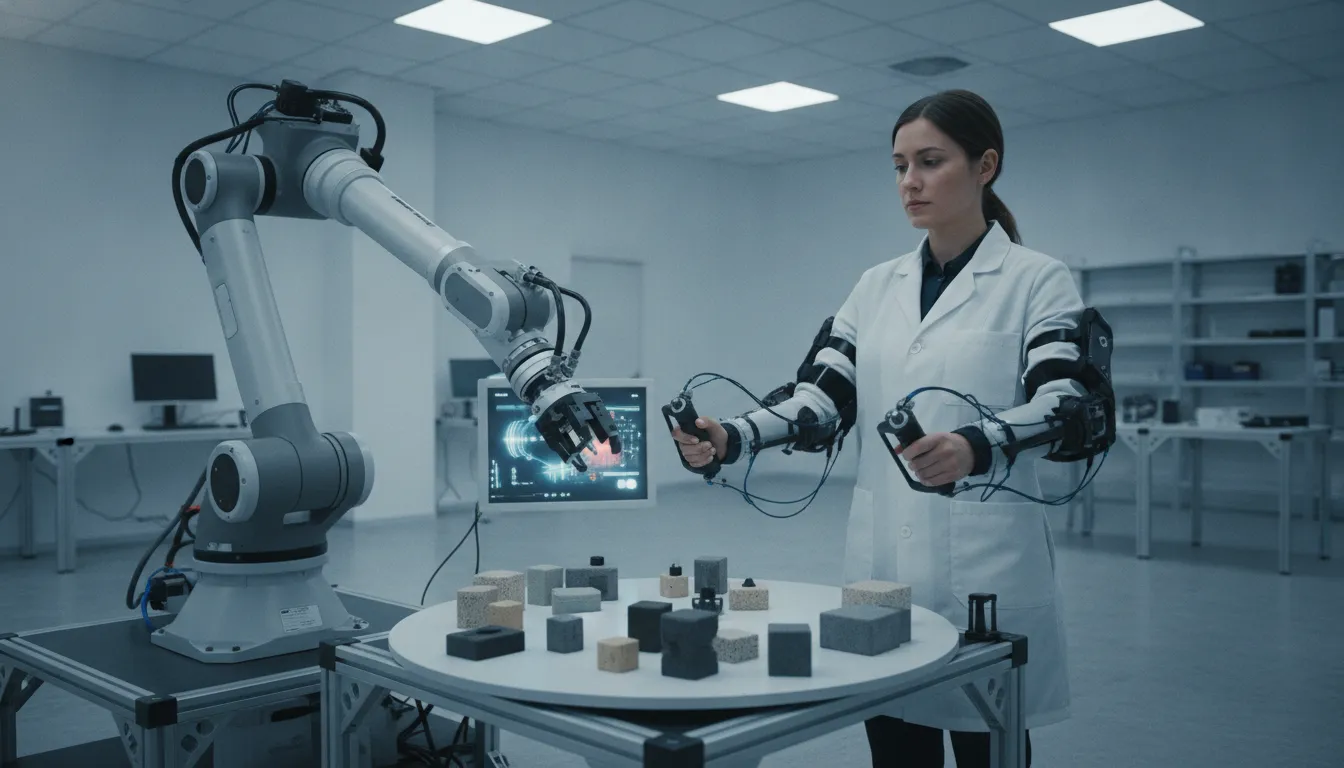
Practical Considerations for Running Foundation Models on Real Hardware
Answer: Deploying foundation models for robot manipulation requires a repeatable loop that connects teleoperation, timestamped demonstrations, standardized data, scalable training, and measured evaluation. Hardware consistency matters as much as model selection because every policy depends on reliable observations, actions, and control.
Build a consistent teleoperation setup
Start with a leader-follower arrangement that lets an operator produce demonstrations naturally and repeatably. Trossen's ambidextrous leader arms use sliding rail finger pinchers, supporting demonstrations with either hand and making the setup practical for bimanual workflows. Match the operator interface, camera placement, workspace geometry, and robot configuration across sessions. Consistency reduces variation in the demonstrations and makes later comparisons between policies more meaningful.
Capture demonstrations with precise timing
Data quality is determined by more than the final joint positions. The Trossen SDK records joint states at up to 200 Hz and attaches microsecond-precision timestamps, giving training pipelines a precise relationship between robot motion and synchronized sensor observations. Record complete episodes with task metadata, reset conditions, camera streams, and success labels where applicable. This makes it easier to identify failed demonstrations, reproduce a run, and prepare datasets for different policy architectures.
Preserve a portable recording format
Use a format that supports both immediate inspection and future model changes. TrossenMCAP provides binary recording for efficient storage and transport, with automatic export to LeRobot V2. That conversion path helps teams move from captured demonstrations to training workflows without maintaining a separate, fragile transformation script for every experiment. Keep the raw recordings and exported datasets versioned so a new preprocessing choice does not overwrite the source evidence.
Train where the workload fits
For local iteration, a TOTL workstation can provide a controlled environment for dataset checks, fine-tuning, and policy inference tests. Cloud infrastructure becomes useful when experiments require larger models, parallel runs, or more GPU capacity than the lab workstation provides. In either case, record the model version, dataset revision, hyperparameters, and hardware configuration. Those details turn a promising run into a reproducible experiment rather than an isolated result.
Evaluate on the target task, then refine
Run evaluation episodes on the same class of hardware and workspace where the policy will operate. Track success rate, completion time, recovery behavior, and failure modes, not only aggregate reward. Trossen's 6-DOF arms support payloads up to 1.5 kg, while QDD actuators provide hardware-based gravity compensation and a 500 Hz control frequency for responsive execution. Use evaluation failures to decide whether the next iteration needs better demonstrations, changed camera views, data balancing, or model adjustments. For a broader framework on deploying robot manipulation systems, connect model development to operational requirements early. Long training and evaluation cycles also benefit from Trossen's lifetime support commitment and US-based engineering team.
Choosing the Right Foundation Model for Your Research
Answer: Choose pi0 when your priority is single-arm dexterous manipulation and a diffusion-based VLA workflow. BiACT when coordinated bimanual behavior is central, and OCTO when open-source flexibility and broad data diversity matter most. All three can run on Trossen platforms, so the decision is primarily about task structure, data strategy, and the research community you want to build with.
Model | Best fit | Data and ecosystem considerations |
pi0 | Single-arm dexterous tasks and general-purpose VLA policy research | Diffusion-based policy that can benefit from larger datasets. Trossen supports OpenPi for pi0 workflows. Physical Intelligence provides substantial industry momentum, including more than $1B in reported funding. |
BiACT | Bimanual tasks requiring coordinated action across two arms | Extends ACT-style action chunking for bidirectional coordination. Plan for approximately 10 to 50 demonstrations per task, and take advantage of the strong academic ALOHA ecosystem and Trossen Stationary AI and Mobile AI platforms. |
OCTO | Open-source generalist research across varied tasks and embodiments | Benefits from broad pre-training and diverse data. Its LeRobot pipeline alignment supports researchers who want to inspect, adapt, and extend the data and fine-tuning workflow. |
Match the model to the experiment, not the benchmark
For a focused single-arm study, pi0 offers a practical path from teleoperated demonstrations to policy inference. While OCTO is attractive when comparing tasks or drawing on varied pre-training data. BiACT is the more direct choice when success depends on temporal coordination between two manipulators rather than independent arm behavior. The model should follow the physical demands of the experiment and the type of evidence your team needs to collect.
Account for the platform and support horizon
Hardware compatibility does not need to constrain this shortlist. Trossen platforms support all three model families, with configurations ranging from the $11,385.95 Solo AI to the $37,845.95 Mobile AI with laptop. Trossen serves more than 400 universities and 10,000 customers globally, giving research teams a practical support and collaboration base as projects move from first experiments toward repeatable deployment. Explore the available robot arm manipulation systems when mapping model requirements to workspace, mobility, and data-collection needs.
Frequently Asked Questions
What are foundation models in robot manipulation?
They are broadly trained models that connect visual observations, language instructions, and robot actions. Instead of learning only one fixed behavior. A model such as pi0 or OCTO can provide a starting policy for multiple manipulation tasks and robot embodiments, then be adapted with task-specific demonstrations.
How do foundation models enable more general-purpose robots?
Foundation models transfer patterns learned from diverse robotic data to new tasks, objects, and environments. In practice, researchers combine pretrained policies with teleoperation data, action chunking, and targeted fine-tuning. This creates a repeatable path from a general policy to a system evaluated on the specific hardware and workflow it must operate.
Which model is best for bimanual manipulation?
BiACT is the most directly aligned option when a task requires coordinated movement from two arms. It extends action-chunking methods for bidirectional bimanual control. While pi0 and OCTO may be better starting points for single-arm tasks or research programs built around their existing ecosystems and data pipelines.
What hardware and data pipeline do I need to run these models?
You need compatible robot interfaces, cameras, a reliable teleoperation workflow, and data that can be converted into the model's expected format. Trossen's SDK supports LeRobot V2 integration and records joint states at up to 200 Hz with microsecond-precision timestamps, helping teams collect, inspect, and evaluate demonstrations consistently.
How do I evaluate a foundation model on a real robot?
Start with a defined task set, controlled demonstrations, and repeatable success criteria. Validate the policy in simulation or offline playback when possible, then run trials on the target hardware while logging observations, actions, timing, and failures. Compare success across objects, environments, and operators before expanding the deployment scope.
Ready to choose your research platform?
The right hardware can help your team move from model experiments to repeatable manipulation workflows with less integration friction. Trossen Robotics can help you compare platforms for pi0, BiACT, or OCTO based on your task design, embodiment, and data collection needs. Get a quote for a Trossen Robotics platform configured for foundation model research, and start planning a practical path from evaluation to deployment.
Comments